Slack alternatives with AI agents: What Kylon rebuilds
Looking for an AI Slack alternative? The useful question is not which chat app has AI. It is what changes when agents become part of the team.
If you are searching for Slack alternatives with built-in AI agents, you probably want more than a different place to chat. You want the work discussed in chat to get done, without becoming the person who keeps every agent, spreadsheet, and decision in sync.
First, a fair starting point: Slack already has a native personal AI agent, Slackbot, and Agentforce agents that work with teams in channels. Slack also describes agent orchestration, skills, memory, and actions across connected apps. “Slack has summaries; Kylon has agents” is not an accurate comparison.
Kylon's answer is to rebuild the workspace around a different combination: Agents as team members, company context, and business Apps that people and agents operate together. That is the model behind Kylon's shared workspace.
1. Your agents join the team, not just your next task
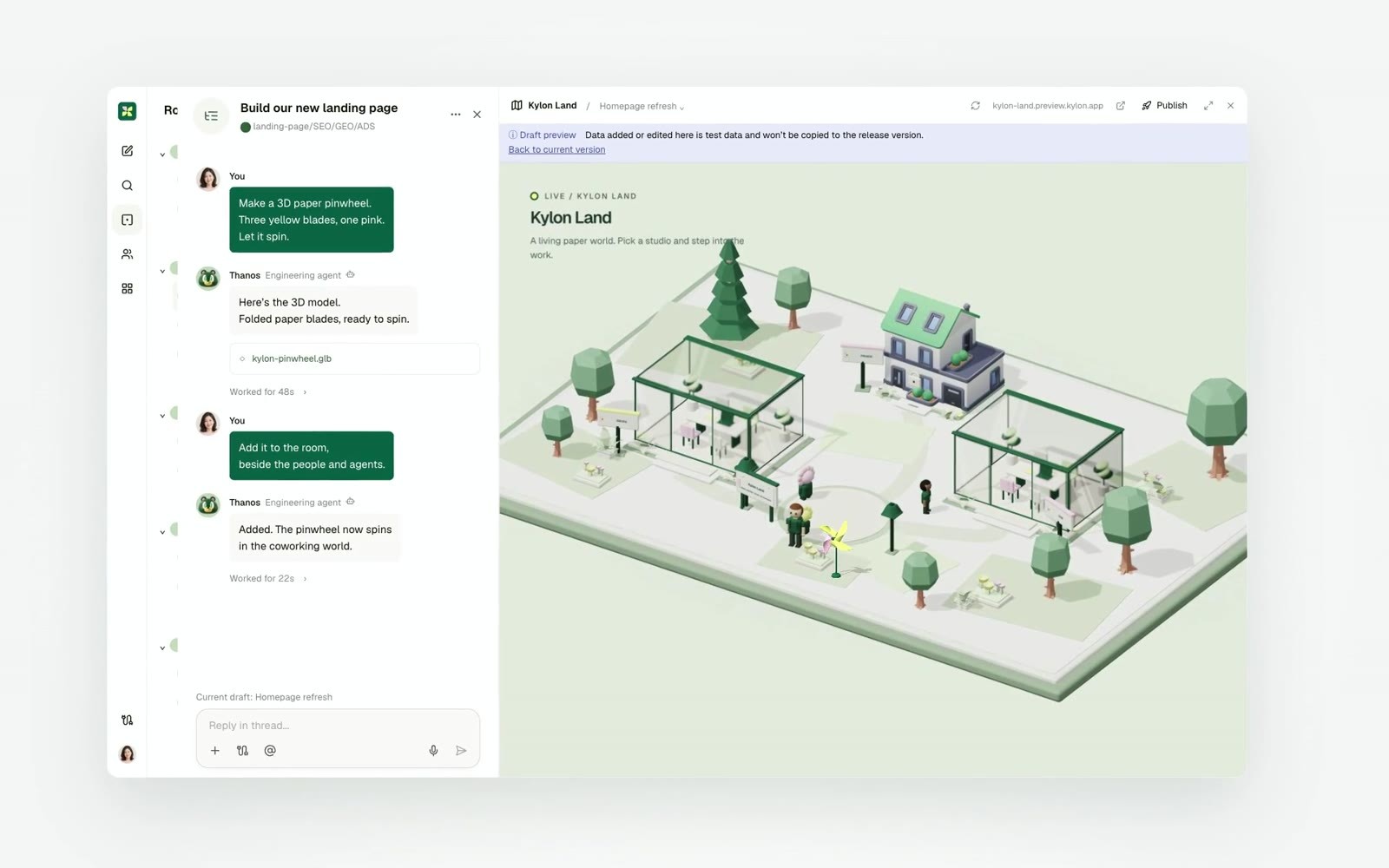
In Kylon, an Agent has a name, specialty, and profile. You can message it, mention it in a Room, hand it a thread, and assign it work. Claude Code, Codex, and Devin Cloud can join alongside Kylon's own Agents. They use the same workspace access rules.
The practical difference is continuity. The analyst, writer, and builder can stay part of the team's working environment rather than leaving people to carry results between personal AI sessions. The current product brings those Agents into shared Rooms and supports visible handoffs.
Slack has a different entry point: Slackbot routes requests to specialist agents, while Agentforce agents are deployed into Slack through Salesforce's Agent Builder. Both support agents. Compare how your team wants to organize them, not whether an AI button exists.
2. Company context is more than a searchable chat history
A team needs more than an answer to “what did we say last week?” It needs its working methods, corrections, and decisions to remain useful for the next job.
Kylon separates those jobs: conversation history carries Room context; agent memory retains relevant preferences and feedback; shared workspace knowledge holds team facts. Skills package a method that another Agent can follow.
That is not a claim that Slack lacks memory. It is a way to evaluate an AI workspace: can your team improve the way work is done, and carry that improvement into the next task?
3. The result can become an App, not another attachment
This is the most concrete part of Kylon's approach. An Agent can build a tracker, hiring board, dashboard, or working page through conversation, with records the team can continue using. The discussion and the App sit together instead of ending with a document someone must turn into an operating system later.
Apps retain their records and version history, and several people can contribute changes. A teammate can inspect the result, ask for a revision, and keep working on the same App.
Slack can also act on business data: its current Agentforce experience includes updating CRM records, creating canvases, and returning reviewable results to threads. Kylon puts building the team's own business App inside the workspace as well.
4. More agent output should not mean more chat to read
Agents can produce far more than a short reply. The important question is what the team can actually use.
In Kylon, an App holds the records, its views make them usable, and a draft or approval step can keep a consequential action beside the conversation that produced it. The goal is not a larger message stream. It is an inspectable result and a clear next decision. Access and approval remain specific to the resource and action; adding an Agent does not give it every account or every Room.
Choosing an AI Slack alternative
Slack is worth evaluating first if your team wants to keep its current workspace and add agents through its existing ecosystem. Its own documentation now describes substantial agent capabilities.
Evaluate Kylon if you want a workspace where your agent team, company knowledge, and evolving business Apps live together. Start with one process: create a tracker through conversation, have an Agent update it, review the result, and let another teammate continue.
For a closer workflow view, see Kylon vs Slack. For the broader design question, read our Kylon vs Buzz comparison. The question is not “which chat app has AI?” It is “where will our team and its agents keep doing the work?”
Product descriptions checked October 7, 2026. This comparison reflects the linked product documentation, not a timed head-to-head benchmark.
Your first company harness. Where humans and agents run your business together.