AI OS
Build and run your business AI OS on Kylon
Your team, Kylon Agents, Claude Code and Codex, working from the same context and data.






What the team sees
Workspace
Where people ask and Agents answer, in the open.
In Kylon: Rooms and threads
Custom software
Small tools for one job, on the same data.
In Kylon: Apps
Agents
Kylon Agents next to the Claude Code and Codex your team already runs.
In Kylon: Agents and Invite my agent
What it runs on
Context
What the company knows and how it decides.
In Kylon: Workspace knowledge and Agent memory
Work record
Who asked, what ran, who approved.
In Kylon: Thread history, searchable
Data
Mail, calendar, CRM and documents, read where they live.
In Kylon: Connections
Access and approvals
Who can touch what, and where a person signs off.
In Kylon: Permissions and Approve
What is an AI OS?
An AI operating system (AI OS) is the layer a business runs on when AI agents do part of the work: shared context about the company, connected data, agents with defined roles, a workspace where people and agents work together, a record of the work, controls over who can do what, and the software built on top.
“We're heading into what I call the platform era, which is more of like a, it's like a whole office.”
In the product
One request, three members, one approval
A Kylon Agent and Claude Code take one step each. The person who asked approves the reply.
Maya asks in the support Room. Iris, a Kylon Agent, pulls Acme's history. Ada is Claude Code on Sam's MacBook: it finds the cause and opens a pull request for Sam. Iris drafts the reply and Maya approves it. The frame is live, so click it. Illustrative data.
The seven layers
Every layer, and where it lives in Kylon
From Liam Ottley's livestream. Pick one to see it in Kylon.
Context in Kylon
Workspace knowledge
- Company overviewWhat we sell, to whom, and why
- How we priceDiscount rules and who signs off
- Client tone of voiceHow replies to clients should read
Iris remembers
Acme reads its export at 7am, so a failure there gets a reply before then.
Illustrative data.
For the whole team
From one person's AI OS to your team's
Keep the Claude Code or Codex you built it in. How it works
Before Kylon
One person's AI OS

- Colleagues ask the person who built it to run things for them.
- Context lives in one person's files, so the next hire starts from zero.
With Kylon
Your team's AI OS
- Anyone in the Room @mentions the Agent that fits the job.
- Claude Code and Codex join as members, still on the computers they run on.
Watch
Watch one built from an empty workspace
Liam Ottley sets up his business on Kylon live. Pick a part.
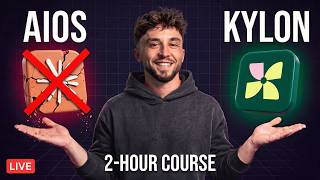
Liam Ottley, Build and Sell No-Code AI Operating Systems with Kylon. Kylon sponsors Liam's videos about Kylon.
Guides
AI OS guides
Watch



Questions people ask
What is an AI OS?
An AI operating system, or AI OS, is the layer a business runs on when AI agents do part of the work. It brings together shared context about the company, connected data, agents with defined roles, a workspace where people and agents work together, a record of the work, controls over who can do what, and custom software built on top.
Is an AIOS the same as an agentic operating system?
In business use the terms mean the same thing: a system where agents and people run the work together. Some research projects use the name AIOS for an operating system that schedules LLM agents at the system level, such as agiresearch/AIOS on GitHub. This page is about the business kind.
I already run an AI OS in Claude Code. Do I start over?
No. Bring Claude Code or Codex into a Kylon workspace as an Agent and keep the skills and context you built. The team then works with it in Rooms, with permissions and approvals around it.
How is an AI OS different from a second brain?
A second brain stores what one person knows. An AI OS adds agents that act on that knowledge, live connections to the business's tools, and controls that let a whole team use it.
I build AI operating systems for clients. Where do I start?
Deliver each client's AI OS into its own Kylon workspace, hand it over to the client's team and keep maintaining it. The partner program covers workshops, delivery and how partners charge for it.
What does it cost?
Kylon plans are on the pricing page. Model and tool usage depends on how much work the Agents do.
Start with one job. Grow it into the way your business runs.
Kylon sponsors Liam Ottley's videos about Kylon, including the livestream quoted on this page. The layer mapping is ours.