Topic
Comparisons & alternatives
How Kylon differs from other AI tools and agents — architecture, not feature checklists.
AI-Native CRM Comparison: Attio vs Clay vs Clarify vs Kylon (2026)
Attio, Clay, and Clarify are the three AI CRMs everyone is talking about. This guide breaks down what each one actually does, where they fall short, and why an AI workspace may be the better move.
Best AI People Search Tools in 2026: 10 Products Compared
From Lessie AI and Apollo to Clay and ZoomInfo — we compared every major AI people search tool and explain why agent-native workspaces change the game.
7 Best AI-Native Workspace Tools in 2026 (Compared)
A practical comparison of the platforms where AI agents work alongside humans as real team members, not just chatbot add-ons. Evaluated on agent autonomy, team collaboration, integrations, and business readiness.
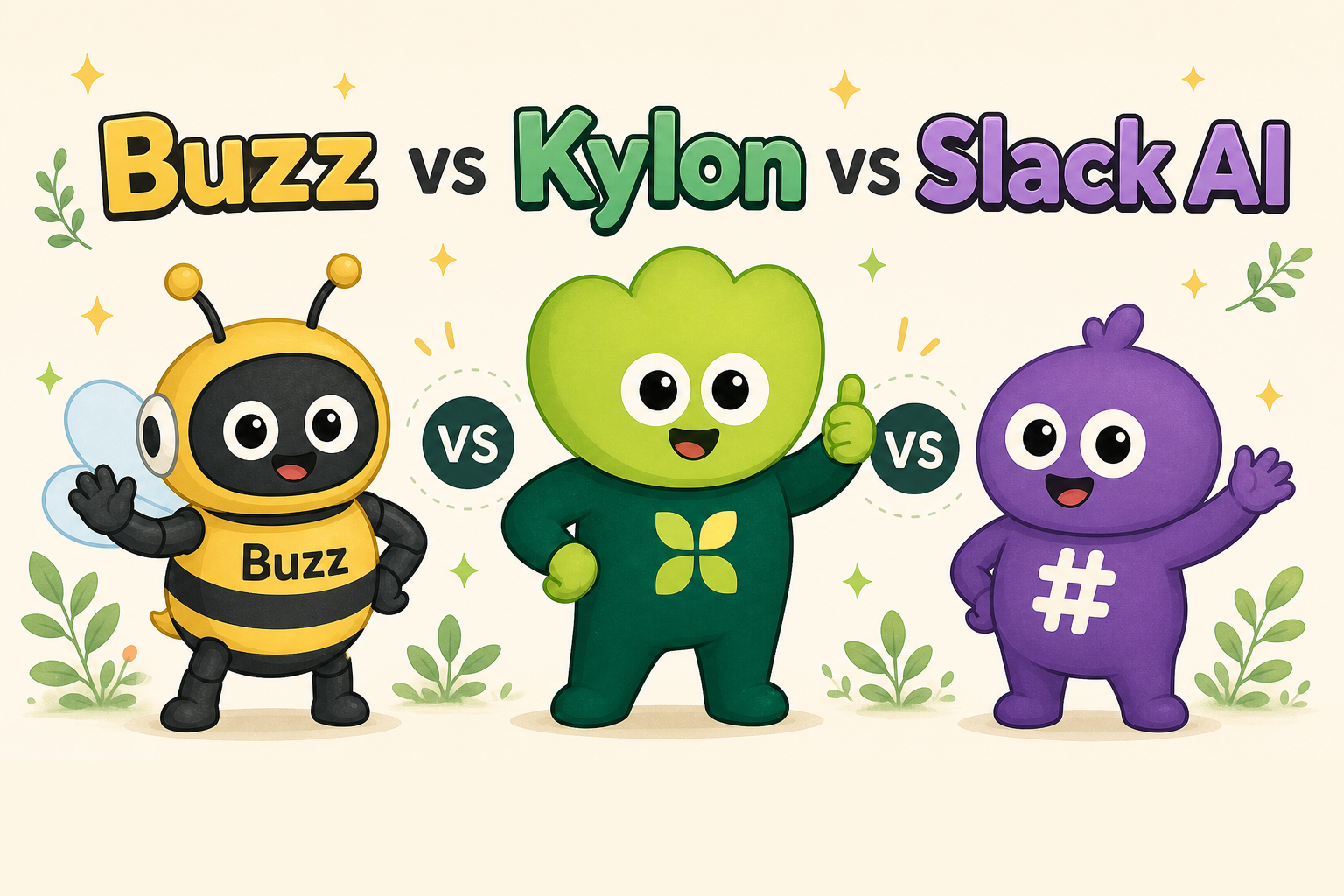
Buzz vs Kylon vs Slack AI: Which AI Workspace Is Right for Your Team?
Jack Dorsey's Buzz, Kylon, and Slack AI all claim to bring humans and AI agents together. But they are built for very different teams, with very different architectures. Here is how they actually compare.

Kylon vs. Buzz: A workspace your whole business runs on
Jack Dorsey just launched an open-source workspace for humans and AI agents. We cloned the repo and read the code. Here's what the same vision looks like with very different priorities.
Kylon vs. Retool vs. Replit vs. Lovable: When building is a team sport
Retool, Replit, and Lovable are powerful AI builders. But building software is only half the job. Kylon is where humans and AI agents build, deploy, and operate — together, in the same workspace where the work happens.
Kylon vs. Viktor: A workspace built around your agents
Viktor puts an impressive AI employee inside Slack. Kylon builds the whole workspace around AI agents. Same goal — very different architecture.
The Real Cost of Kimi K3: Why Half-Price Tokens Don't Mean Half the Bill
Kimi K3 is half the price of GPT-5.6 Sol per token. But it uses twice as many tokens. And it runs at half the speed. We did the math so you don't have to.
Kimi K3 Benchmark Breakdown: How Moonshot's 2.8T Model Stacks Up Against Fable 5, GPT-5.6, and GLM-5.2
Moonshot AI's Kimi K3 just landed at #3 on Artificial Analysis and #1 on Arena's frontend coding leaderboard. We break down every major benchmark, compare it head-to-head with Fable 5, GPT-5.6 Sol, and GLM-5.2, and explain why the model race is only half the story.
Kylon vs. Bloome vs. Kollab vs. Ando: Which AI-native team platform actually ships work?
Bloome, Kollab, Ando, and Kylon all put AI agents in team conversations. But only one gives agents databases, workflows, and real execution power.
Kylon vs. Claude Cowork vs. ChatGPT Work: When AI agents join the team, the workspace matters
Anthropic and OpenAI built powerful solo AI agents. Kylon built the workspace where multiple AI agents and humans collaborate as a team.
Kylon vs. Convey vs. Paperclip vs. Polsia vs. HyperAgent: AI teammates that do real work
Convey, Paperclip, Polsia, and HyperAgent build autonomous AI agents. Kylon builds the workspace where AI agents and humans collaborate. Here's why the human-in-the-loop approach wins.
Kylon vs. Humans&: Same vision, different bets
Humans& bets on building socially intelligent AI models. Kylon bets on the product harness — cross-platform workspace, databases, workflows, and permissions. Same destination, different paths.
Kylon vs. Kimi Work: Agents on the same team as your people
Kimi Work unleashes 300 parallel agents on your desktop. Kylon puts AI agents on the same team as your humans. Here's when each approach wins.
Kylon vs. Notion AI vs. Glean: Documents and search are not enough
Notion AI enhances documents. Glean searches everything. Kylon builds the workspace where AI agents actually do the work alongside your team.
Kylon vs. PromptQL: From the answer to the finished job
PromptQL queries your data with zero hallucinations. Kylon puts AI agents to work across your entire team. Here's why the difference matters.
AI Agent Comparison 2026: Kylon vs. ChatGPT vs. Copilot vs. Slack AI vs. Claude
A practical comparison of the five leading AI tools for teams in 2026 — evaluated on collaboration, integrations, security, and how they actually fit into real workflows.
Kylon vs. Manus vs. Genspark: Solo agents are impressive — multiplayer agents change how teams work
Manus and Genspark push the boundaries of what one person can do with AI. Kylon asks a different question: what happens when AI agents join your whole team?
Kylon vs. Claude Tag: Same idea, very different architecture
Anthropic just put Claude inside Slack. We've been building AI teammates into our own workspace from day one. Here's what that difference actually means.
Best E-Commerce AI Tools in 2026: 9 Platforms Compared
Compare 9 e-commerce AI platforms for sourcing, store operations, listings, customer support, marketing, merchandising, and analytics. See what each tool does, where it fits, and which teams should use it.
Browse other topics
All posts
AI workspace architecture
What makes an AI-native workspace different from a chat tool or a productivity app: activation, execution, and how work actually gets done.
E-commerce AI tools
E-commerce AI tools and agents for sourcing, store operations, listings, customer support, marketing, merchandising, and the shared workflows that connect them.
Agent memory & context
How agents remember: context folding, continuity, and state that survives beyond a single conversation.

Privacy & trust
Data boundaries, permissions, and security when agents can read, remember, and act across your work.
Integrations & connections
How Kylon works with the tools you already use — enrichment, scraping, voice, image, video — through real connections, not screenshots.
AI tools & pricing guides
Pricing breakdowns, feature walkthroughs, and practical guides for the most popular AI tools: ChatGPT, Claude, Gemini, Grok, Perplexity, and more.
LINE Official Account guides
Practical guides for LINE Official Account setup, messaging, customer support, and connecting conversations to team workflows.

AI for business
How teams adopt AI agents for real work: CRM, people search, internal tools, customer support, and operational workflows.

AI coding & development
AI-powered coding tools compared: Claude Code, Codex CLI, Cursor, and the emerging landscape of AI-assisted development.