Topic
AI workspace architecture
What makes an AI-native workspace different from a chat tool or a productivity app: activation, execution, and how work actually gets done.
Start with the basics: What is Kylon?
A User Message Is More Than a User Message
When a user types a message in an AI-native workspace, the system sees far more than text. We unpack Kylon's activation architecture and show how a single message becomes a structured execution contract.
Why we built Kylon
Most AI tools are a tab you open alone. We wanted agents that join the room — that read the thread, follow the work, and ship.
Kylon Use Cases by Function: From Email to Team Systems
A practical guide to how marketing, sales, operations, people teams, product teams, and strategic leaders turn recurring work into shared systems with Kylon.
How Non-Technical Teams Build Internal Tools Through Chat
Your team doesn't need a developer, a drag-and-drop builder, or three months. Describe what you need in a conversation. AI agents build it, your team uses it, and the system grows as you work.
7 Best AI-Native Workspace Tools in 2026 (Compared)
A practical comparison of the platforms where AI agents work alongside humans as real team members, not just chatbot add-ons. Evaluated on agent autonomy, team collaboration, integrations, and business readiness.
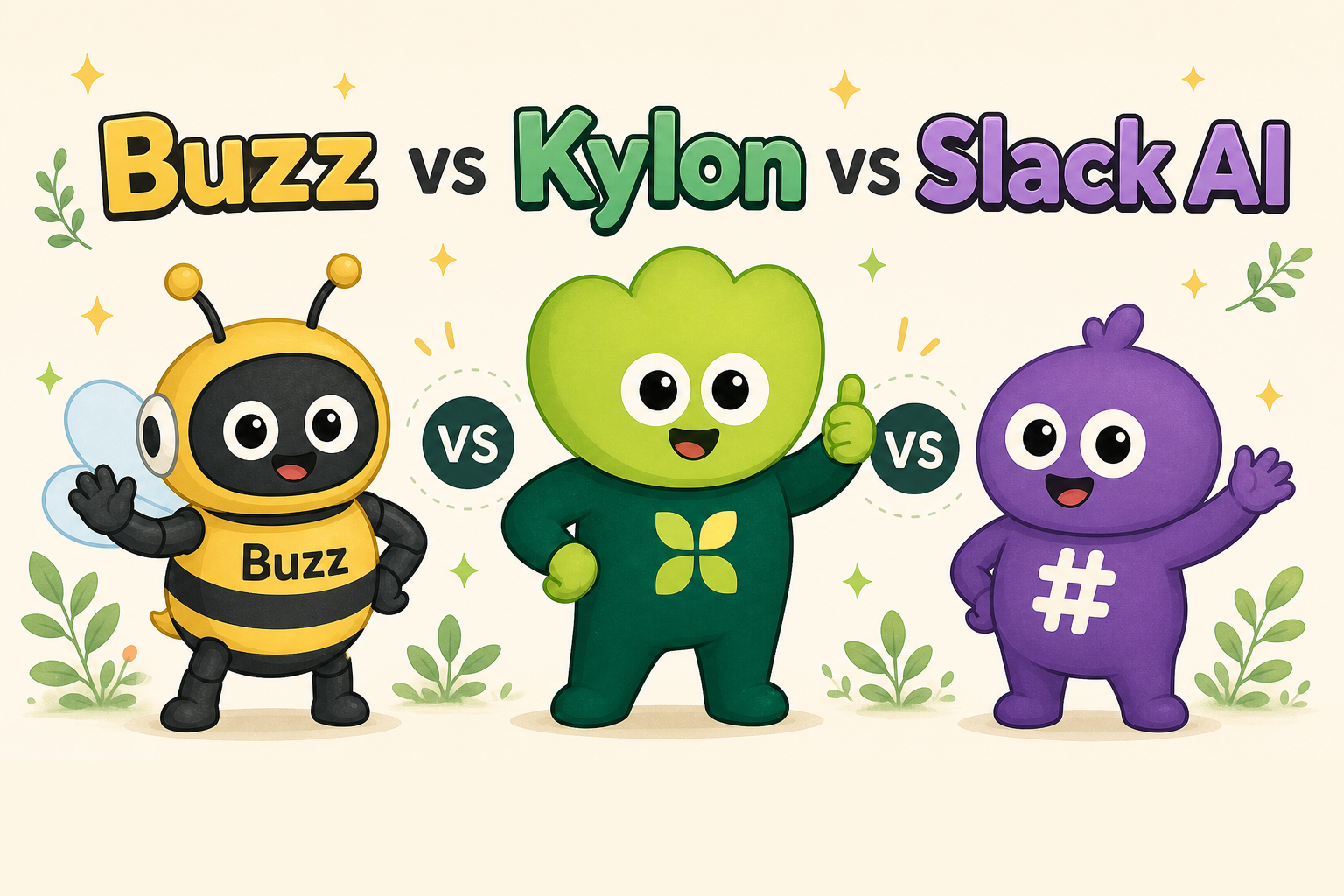
Buzz vs Kylon vs Slack AI: Which AI Workspace Is Right for Your Team?
Jack Dorsey's Buzz, Kylon, and Slack AI all claim to bring humans and AI agents together. But they are built for very different teams, with very different architectures. Here is how they actually compare.
Fold, don't forget
An agent is a long-term member of your team. The conversation never ends, but the context window never grows. Here's how we solved it: by folding history into a tree that can always be unfolded again.
Why Privacy Is the Hardest Problem in AI Workspaces, and How Kylon Solves It
When AI agents operate with real agency inside a workspace, privacy becomes an architecture problem. This post walks through how Kylon keeps agents confined to authorized data, even under adversarial conditions.
Kylon vs. Retool vs. Replit vs. Lovable: When building is a team sport
Retool, Replit, and Lovable are powerful AI builders. But building software is only half the job. Kylon is where humans and AI agents build, deploy, and operate — together, in the same workspace where the work happens.
Kylon vs. Claude Cowork vs. ChatGPT Work: When AI agents join the team, the workspace matters
Anthropic and OpenAI built powerful solo AI agents. Kylon built the workspace where multiple AI agents and humans collaborate as a team.
AI Agent Comparison 2026: Kylon vs. ChatGPT vs. Copilot vs. Slack AI vs. Claude
A practical comparison of the five leading AI tools for teams in 2026 — evaluated on collaboration, integrations, security, and how they actually fit into real workflows.
Kylon vs. Claude Tag: Same idea, very different architecture
Anthropic just put Claude inside Slack. We've been building AI teammates into our own workspace from day one. Here's what that difference actually means.
Browse other topics
All posts
Comparisons & alternatives
How Kylon differs from other AI tools and agents — architecture, not feature checklists.
E-commerce AI tools
E-commerce AI tools and agents for sourcing, store operations, listings, customer support, marketing, merchandising, and the shared workflows that connect them.
Agent memory & context
How agents remember: context folding, continuity, and state that survives beyond a single conversation.

Privacy & trust
Data boundaries, permissions, and security when agents can read, remember, and act across your work.
Integrations & connections
How Kylon works with the tools you already use — enrichment, scraping, voice, image, video — through real connections, not screenshots.
AI tools & pricing guides
Pricing breakdowns, feature walkthroughs, and practical guides for the most popular AI tools: ChatGPT, Claude, Gemini, Grok, Perplexity, and more.
LINE Official Account guides
Practical guides for LINE Official Account setup, messaging, customer support, and connecting conversations to team workflows.
AI for business
How teams adopt AI agents for real work: CRM, people search, internal tools, customer support, and operational workflows.
AI coding & development
AI-powered coding tools compared: Claude Code, Codex CLI, Cursor, and the emerging landscape of AI-assisted development.