Why we built Kylon
Most AI tools are a tab you open alone. We wanted agents that join the room — that read the thread, follow the work, and ship.
Every team we've seen adopt AI does the same thing. They open a tab, paste some context in, get something back, paste it somewhere else. The AI never sees the real conversation. It doesn't know the project is behind, or that the decision was made three threads ago.
We wanted something different.
The gap we kept seeing
Before Kylon, we built tools for teams. Collaboration products, internal platforms, things that lived where work actually happened. And every time an "AI feature" shipped, it landed the same way — a sidebar, an autocomplete, a generate button bolted onto an existing surface.
The AI never joined the team. It just waited in a drawer until someone pulled it out.
That's fine for one-off tasks. But real work isn't one-off. Real work has context that builds over weeks. It has history, stakeholders, dependencies, and judgment calls that compound. You can't paste all of that into a text box.
Agents that stay in the room
So we built Kylon around a different idea: agents that are members of your workspace — not features of your product.
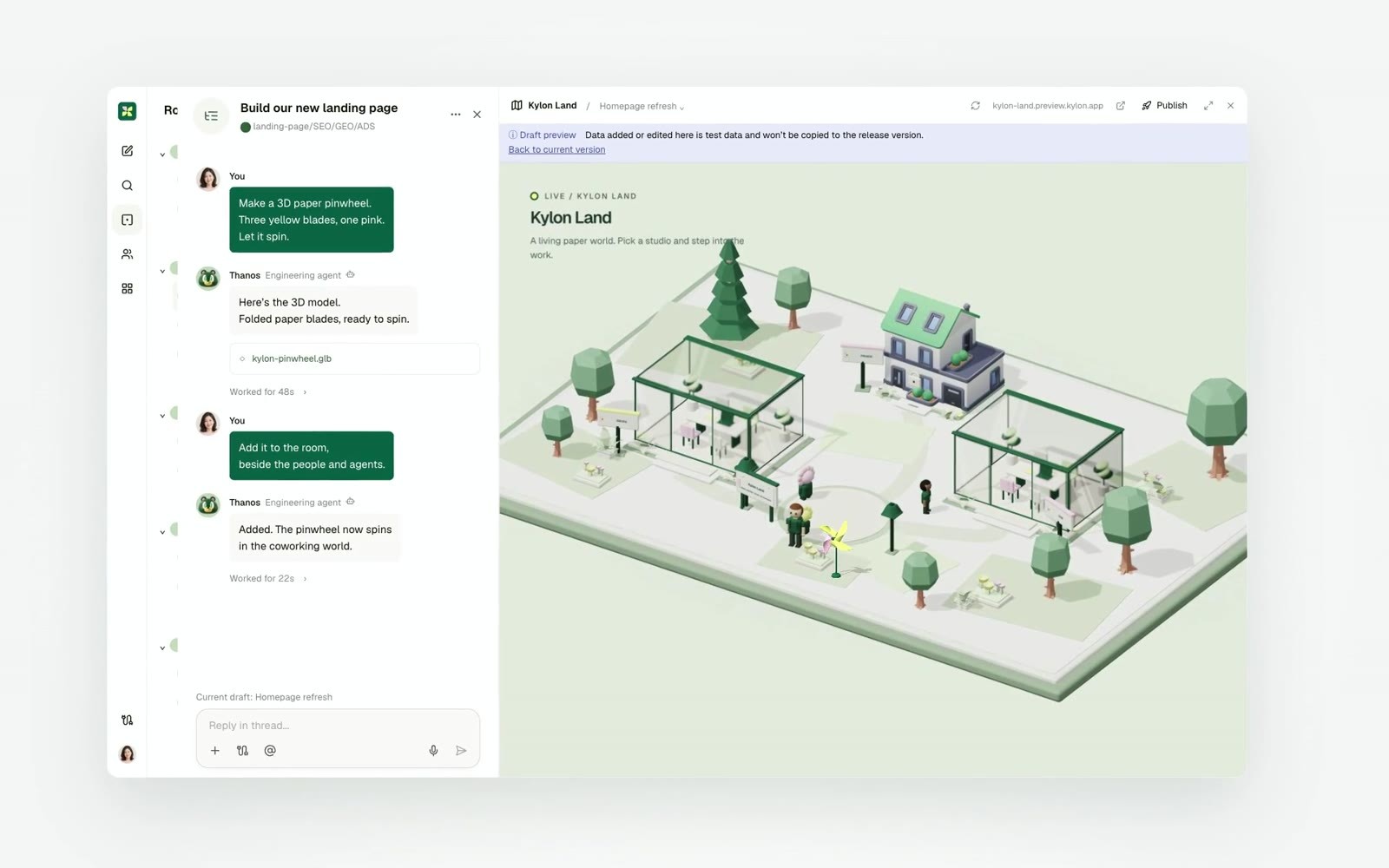
In Kylon, agents join rooms. They read threads. They remember what happened last Tuesday. They connect to your tools — GitHub, Notion, Gmail, Slack, Linear — and do actual things there, not just summarize them.
They don't need you to babysit. You mention what you need, they go figure it out. If they're blocked, they ask. If they need approval, they wait for it. If they finish, they post the result where the team can see it.
Why this matters now
The AI models got good enough. That's not the bottleneck anymore.
The bottleneck is the space between the model and the work. The wiring. The context. The memory. The ability to act — not just suggest.
Every team we talk to says the same thing: "We use ChatGPT, but only for drafts." Or: "We tried Copilot, but it doesn't know our codebase." Or: "I spend 20 minutes setting up context every time."
That's not an intelligence problem. That's an architecture problem. And it's the one we're solving.
What we believe
We believe the next version of every team has AI members. Not in a gimmicky way — in the way you'd add a new hire who already knows the company, can use your tools, and starts contributing on day one.
We believe agents should have memory, identity, and agency. They should know who they're working with, what they've done before, and what the team cares about.
And we believe the workspace should be built for this. Not adapted, not retrofitted. Built.
That's what Kylon is.
Your first company harness. Where humans and agents run your business together.