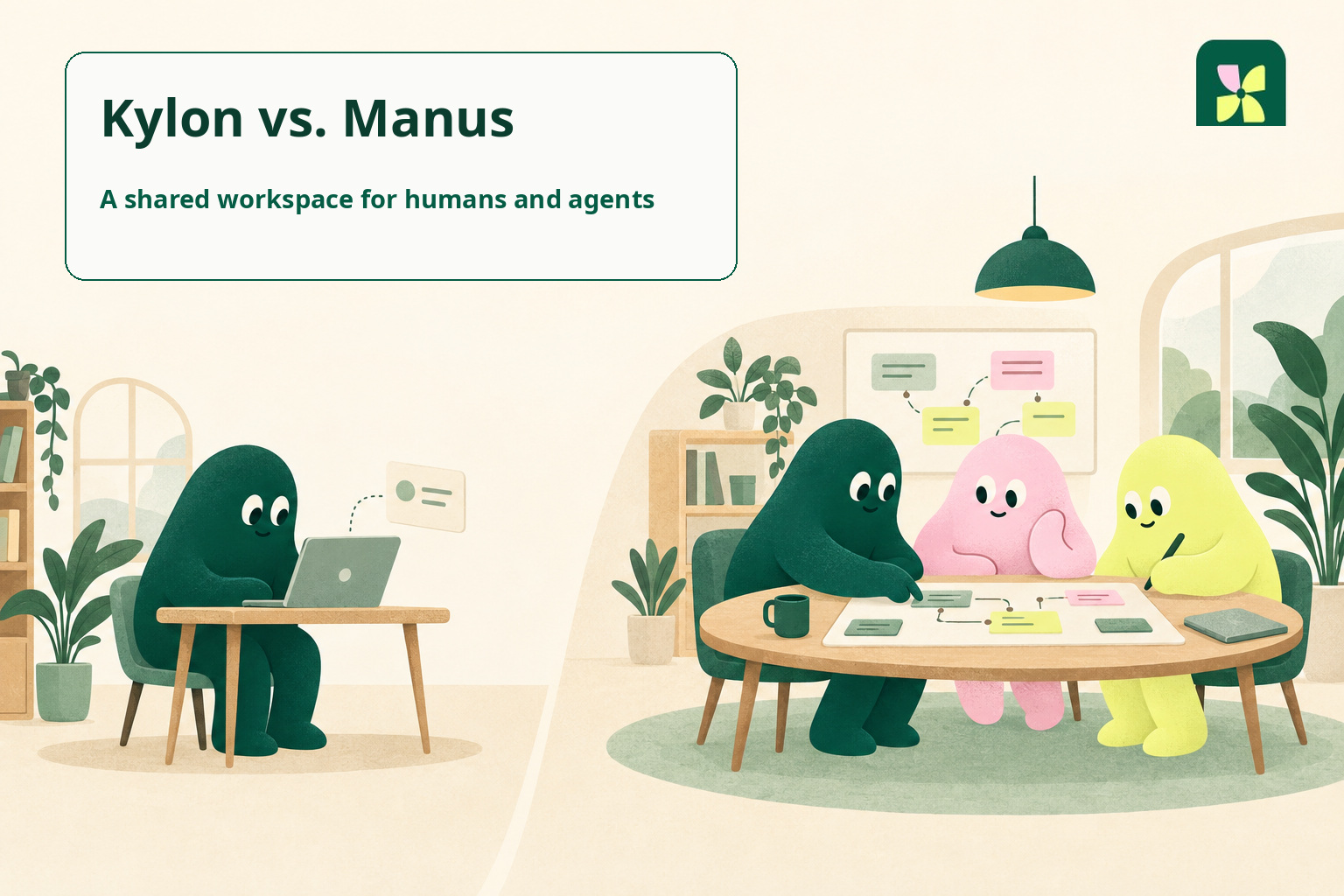
Kylon vs. Manus: A shared workspace for humans and agents
Manus gives an agent a task to execute. Kylon gives teams a shared workspace where people and agents build context, hand off work, and keep processes moving.
The search for a Manus AI alternative often starts with a question about capability. Can an agent research a market, navigate websites, prepare a document, or complete a sequence of steps without constant direction? Those questions matter, but they do not cover the whole operating problem for a team.
A team also needs to know where the request lives, who can review the result, what another agent should do next, and how the work becomes useful context for tomorrow. A finished output is valuable. A process that the whole team can see, continue, and improve is something different.
That is the central distinction in Kylon vs Manus. Manus centers work on a task assigned to an agent. Kylon centers work on a shared workspace where humans and agents are peers. Both can support substantial work, but they organize that work around different units.
Two products with different centers of gravity
As checked on 2026-09-15, Manus presents an agent that can operate a browser and execute multi-step workflows. Its current public experience also foregrounds outputs such as slides, websites, designs, and games. The user defines a goal, the agent works through it, and the result returns to the task.
Kylon starts with a Room where human colleagues work beside several named agents, such as a researcher, analyst, writer, and operator. Each agent can have its own memory and skills. The work stays in visible threads, an App holds the records the conversation produces, and a workflow can continue on a schedule or event. Before an external action goes out, the team can require human approval in the same context.
For an individual request, a task can be enough. For a campaign, research pipeline, customer process, or partner program, the surrounding decisions often matter as much as the first output. Kylon keeps those decisions close to the work instead of asking the team to reconstruct them across separate tools and personal histories.
How agent execution works
Manus offers two documented browser environments. As checked on 2026-09-15, its Cloud Browser runs in an isolated environment where the agent can visit sites, click, fill forms, extract information, and complete multi-step work. A user can watch the activity and take control when verification is needed.
For work that depends on an existing signed-in session, Browser Operator runs in a dedicated local browser tab and uses the user's active logins after authorization. The same documentation distinguishes that local mode from the isolated Cloud Browser, where login takes place inside the cloud session.
Kylon makes execution one stage in a visible team process. Several named specialist agents can share a Room with human colleagues while keeping distinct memories and skills. They work in threads, use connections to act in real services under a named account, update records in Apps, and hand the next step to a scheduled or event-triggered workflow. A human approval step can stop an outbound action until someone reviews it.
Shared context and continuity
As checked on 2026-09-15, a Manus Project stores a master instruction and a knowledge base of uploaded files that apply to new tasks in that project. Project members can share that instruction and knowledge base, while individual tasks remain private unless someone separately shares them.
The timing of updates also matters. Changes to a Project instruction apply when the next message is sent in a current task, while changes to Project files apply only to newly created tasks. Existing tasks retain the file configuration they previously received.
Manus also distinguishes between temporary and persistent execution environments. Standard task environments eventually close after completion, while outputs remain in chat history, and a separate Cloud Computer provides a persistent file system and always-on operation. That gives users several ways to preserve inputs or environments around recurring work.
Kylon treats continuity as a workspace property. The next person opens the same Room and can read the thread, inspect the App records, and see which agent or human made the last decision. Each agent retains its own relevant memory and skills, while shared files and workspace knowledge remain available to the team. Handoffs do not depend on somebody writing a fresh recap.
That is the multiplayer wedge. Shared context reduces the cost of handoff. A research agent can leave findings in the same place where a writing agent receives them. A human can correct an assumption in a thread. A workflow can pick up after approval. The work accumulates for the team rather than remaining useful only inside one person's agent session.
Collaboration beyond sharing an output
Manus does provide real-time collaboration. As checked on 2026-09-15, Manus Collab lets invited participants view one task, prompt Manus directly, see the complete task history, and refine the output together. Participants can also access and export task outputs.
The task remains the collaboration boundary. The owner controls invitations, collaborators need Manus accounts, and simultaneous prompts are processed sequentially. The documentation also says that when the first collaborator joins, login cookies in that task sandbox are cleared, so authenticated browser work may require another login.
Kylon makes collaboration the operating layer. A request can start in a Room, branch into a focused thread, and involve named agents with separate responsibilities, memories, and skills. Their output can update an App, pause for explicit human approval, then continue through a workflow. People see the evidence, records, and pending action on the same surface.
Structured work that stays with the team
Kylon Apps turn conversation into shared operating state. Database Apps hold records that humans and agents can inspect and update, such as prospects, briefs, requests, or campaign items. Custom Apps add a purpose-built interface and logic for the process. The App remains beside the Room and its threads, so a teammate can trace a record back to the discussion that produced it.
Manus can work with external systems. As checked on 2026-09-15, its documented prebuilt MCP connectors include Gmail, Notion, Stripe, HubSpot, Slack, Google Calendar, Google Drive, and GitHub. The same documentation covers custom MCP servers, Zapier, Slack, and API options for proprietary systems, event-driven workflows, notifications, and embedded capabilities.
Kylon connections let an agent act in real tools under a named authorized account, not merely suggest the next click. The Room supplies context, a skill defines the method, an App stores the result, and a workflow determines when the process runs again. Human approval can remain the final gate before a message, update, or other external action goes out.
Kylon vs Manus: how the work operates
The table below focuses on operating model and scope. Manus details were checked on 2026-09-15.
| How the product works | Manus | Kylon |
|---|---|---|
| Primary unit | A task, optionally created within a Project that supplies instructions and files. | A durable Room where human colleagues and several named agents share threads, files, Apps, and workflows. |
| Agent execution | Multi-step work in a Cloud Browser or an authorized local Browser Operator session. | Named specialist agents use their own memory and skills, act through authorized connections, update Apps, and hand work to workflows. |
| Shared context | Projects provide a master instruction and knowledge base to new tasks. | Threads preserve decisions, Apps preserve records, and agent memory plus workspace knowledge let the next person or agent continue without a fresh recap. |
| Live collaboration | Collab participants can view and prompt the same task in real time. | Humans and several agents work in the same Room, with visible handoffs, focused threads, and shared review. |
| Structured data | Connectors let the agent read data and perform actions in authorized external apps. | Database Apps turn conversation into shared records; Custom Apps add the interface and process logic the team needs. |
| Reusable methods | Skills package reusable instructions, procedural knowledge, and tools. | Each agent can carry specialized skills, while scheduled or event-triggered workflows make the method operational. |
| Continuity | Project configuration carries into tasks, with a separate persistent Cloud Computer also documented. | Durable threads, structured App records, agent memory, and running workflows preserve both the decision trail and the next step. |
| Human review | Users can watch Cloud Browser activity, take control, and collaborate in a shared task. | A human approval gate can hold an external action until someone reviews the discussion, evidence, and record in context. |
What Kylon is for
Kylon is for teams that want a staffed operating room, not a series of isolated agent runs. Put human colleagues beside several named agents, give each agent a defined role, memory, and set of skills, and keep the work in threads that preserve the evidence and decisions.
A complete process can live there. A research agent gathers evidence. An analyst updates the shared App. A writer prepares the next action. A human reviews the thread and approves it. An operator uses a connection to act in the real service under a named account. A workflow schedules the follow-up or starts it when an event arrives. If responsibility changes, the next person can read the thread, inspect the record, and continue.
That model fits campaign operations, research pipelines, content production, customer requests, partner management, reporting, and internal knowledge workflows. Apps hold evolving business state rather than leaving it inside attachments. Skills make the team's method reusable. Agent memory and workspace knowledge carry forward what should not be rediscovered. Workflows keep the agreed process running while approval gates preserve human control over outbound action.
This is multiplayer work in concrete terms: several specialists, one shared context, visible handoffs, structured records, and a human decision at the point that matters.
What a team can do on day one
Create one Room for a live process and add the people who own it. Bring in named agents for research, analysis, writing, and operations, each with the appropriate skills. Connect the services they need under the correct accounts, create an App for the records produced, and define which external actions require approval. Then schedule a recurring workflow or attach it to an event. The first run already leaves behind a thread, a structured record, and a clear next step for the team.
Choosing a Manus AI alternative
The right choice begins with the unit of work you need.
If your main requirement is to give an agent a defined goal and let it perform multi-step browser work, Manus is organized around that model. As checked on 2026-09-15, its Cloud Browser, Browser Operator, Projects, Collab, Skills, and integrations extend task execution with browser environments, reusable context, collaboration, specialized methods, and connected services.
If the requirement is a shared operating environment, evaluate what happens before and after the agent run. Can another person understand the decision? Can a second agent continue without a manual recap? Can the result update a shared record? Can review happen beside the source context? Can the process run again on a schedule or event?
Kylon is built around those questions. Humans and agents are peers in a workspace, not separate users passing isolated outputs between tabs. Rooms provide the shared context. Threads preserve focused decisions. Apps keep structured state. Skills and connections give agents repeatable methods and authorized reach. Workflows carry the process forward.
A capable solo agent can multiply one person's output. A multiplayer workspace can help the team's work compound.
Your first company harness. Where humans and agents run your business together.