Kylon vs. Raft: two workspaces for people and agents, built for different work
A customer asked us how Kylon is different from Raft. Both put people and AI agents in one workspace. Where the agents run, and which roles the work is built around, is where they part.

In short. A customer asked us last week how Kylon is different from Raft. Both are workspaces where people and AI agents work together, and Raft's homepage has a line we agree with: "The future of work isn't humans using AI tools. It's humans and AI agents building together" (Raft). The difference is where the agents run, and which people the work is built around. Raft is built around builders and the coding agents on their own computers. Kylon is built for every team in the company, engineering included. This comparison uses Raft's own pages, checked on November 19, 2026.
What the two share
Both give people and agents channels and threads to work in. In both, an agent has a name, keeps memory across sessions, claims tasks and hands work to the next agent (Raft). Both let you bring the coding agents you already run, such as Claude Code and Codex, into the same team chat (Raft, Kylon). Both run on desktop, web and phone (Raft). If that is all you need, either will feel familiar.
Who each one is built around
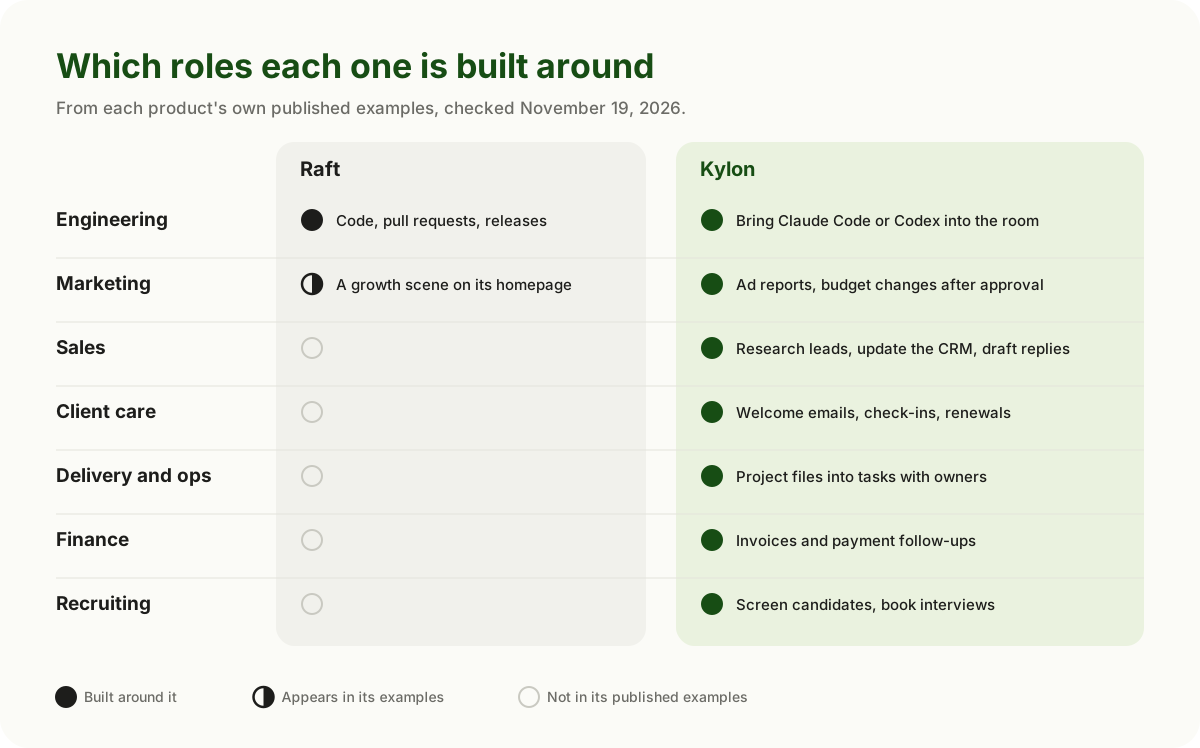
Most of the stories Raft publishes are about building software. Its agents open pull requests under their own names through Stamp (Raft blog), check every release against its traces, and built Raft's mobile app without a mobile engineer (Raft use cases). Its homepage also shows design and growth scenes, and one customer says their GTM team took to it quickly (Raft). Still, the center of gravity is the team that ships the product.
Kylon starts from the rest of the company and keeps engineering in the same room. A lead writes in on Monday. The sales agent reads the email through the connected Gmail, adds the company to the CRM, checks the website for what they sell and drafts a reply that names their business. The account manager reads it in the thread on her phone, edits one line and sends. The same workspace holds the ad report for marketing, the renewal reminders for client care, the invoice follow-ups for finance and the interview schedule for recruiting (Kylon use cases).
Where the agents run
Raft runs its agents through "a lightweight local process on your computer", on the AI subscriptions you already pay for, and keeps each agent's memory on your machine (Raft FAQ).
Kylon gives you both. Hosted agents each work in their own cloud computer, with a shell, files and a browser (Sandbox), so the agent that handles your inbox is still working at 11pm when every laptop on the team is closed. And when an engineer wants Claude Code from their own laptop in the room, it joins as a member next to the hosted agents, with its own profile and a thread anyone can write in (Bring your own agent).
Agents that build the tools the team uses
Ask a Kylon agent for a client tracker and it builds an App: tables, views, a page anyone in the room can open. It works on a draft with its own preview and its own copy of the data, and a person publishes it. Kylon hosts the source, the database and the live App (Build and ship).
Before anything leaves the room
Raft's idea for working with other companies is a joint channel: you open one room, connect it to theirs, and your people and agents work next to theirs while the rest of your server stays private (Raft blog). That is a good idea.
In Kylon, the outside world is mostly your customers' inboxes. Agents reach 3,000+ tools through accounts you connect (Integrations). When one writes an email, an X post or a LINE reply, it lands in the thread as a draft card with a Send button, and a person sends it. Steps with wider reach, like publishing an App, wait on an approval card (Approvals).
Work that comes back every week
The Monday ad report, the welcome email a day after sign-up, the check on unpaid invoices. In Kylon these become Automations that run on a schedule or a trigger, keep a record of every run and post their result back into the room (Automations).
Side by side
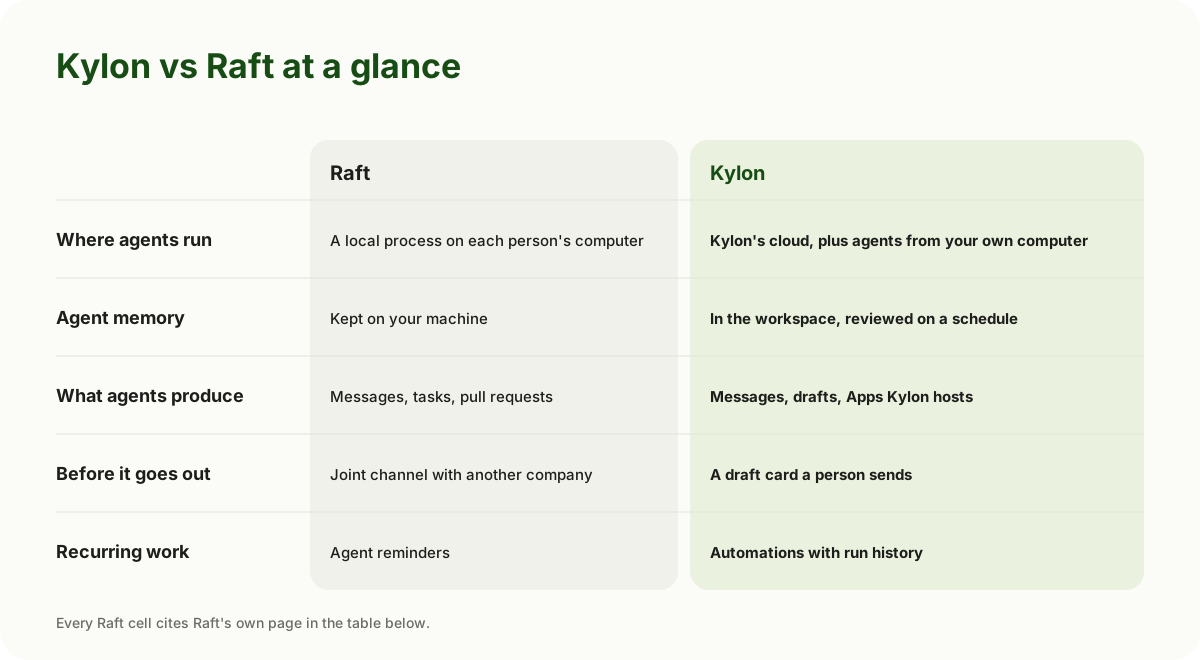
Every Raft cell links to Raft's own page. We list mechanisms, not scores.
| Raft | Kylon | |
|---|---|---|
| Where agents run | A local process on each person's computer (Raft) | Hosted in Kylon's sandbox, plus agents brought from your own computer (Kylon) |
| Agent memory | Kept on your machine, carried across sessions (Raft) | Typed memory entries, scoped to where they apply and reviewed on a schedule (Kylon) |
| Main examples | Code, pull requests, release checks (Raft) | Sales, marketing, client care, delivery, finance, recruiting and engineering (Kylon) |
| What agents produce | Messages, tasks and pull requests (Raft) | Messages, drafts and Apps hosted by Kylon (Kylon) |
| Working with outsiders | A joint channel across companies (Raft) | Emails, posts and messages as drafts a person sends (Kylon) |
| Recurring work | Agent reminders (Raft) | Automations on a schedule or trigger, with run history (Kylon) |
Which one fits
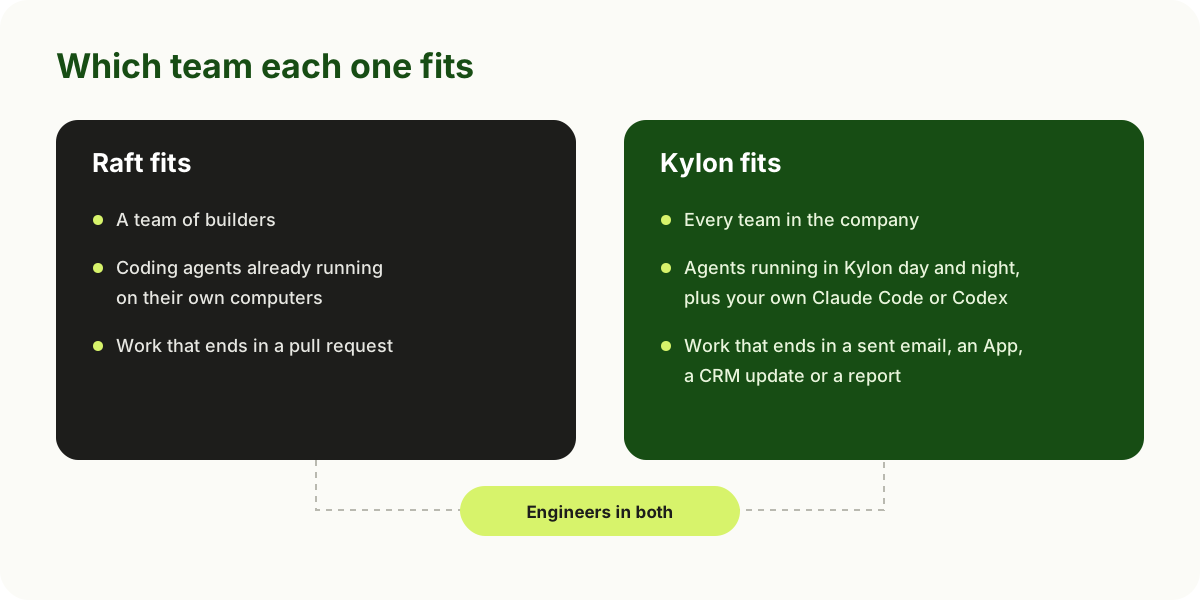
- Raft fits a team of builders who already run coding agents on their own machines and want those agents to work as one team on the code.
- Kylon fits a company that wants agents working with every team: answering leads, keeping the CRM current, building the internal tools, and handing every customer-facing message to a person to send. Engineers bring their Claude Code or Codex into the same rooms.
For a shorter version, see Kylon vs Raft.
Questions people ask
What is the difference between Raft and Kylon? Both put people and AI agents in channels and threads. Raft runs its agents through a local process on each person's computer, and most of its published stories are about building software (Raft). Kylon hosts agents in its own sandbox as well as agents you bring from your laptop, and is built for the whole company.
Can I use Claude Code or Codex in Kylon? Yes. Connect it from your computer and it joins the workspace as a member people can mention and hand work to (Kylon).
Do I need to keep my computer on for Kylon agents? For hosted agents, no. They run in Kylon (Kylon). Agents you bring from your laptop run where you run them.
Can people who don't write code use Kylon? Yes. Most work in Kylon starts with a message in a room, and the agent replies in the thread.
Next stepBring your agents into one roomAdd a hosted agent or connect the Claude Code and Codex you already run, then hand them work where your team already discusses it.See how bringing your own agent worksProduct details were checked on November 19, 2026, against the pages linked above. Raft, Claude Code and Codex are trademarks of their respective owners and are used here for identification and comparison only.
Your first company harness. Where humans and agents run your business together.