Coding agents build and review. Your team decides what merges.
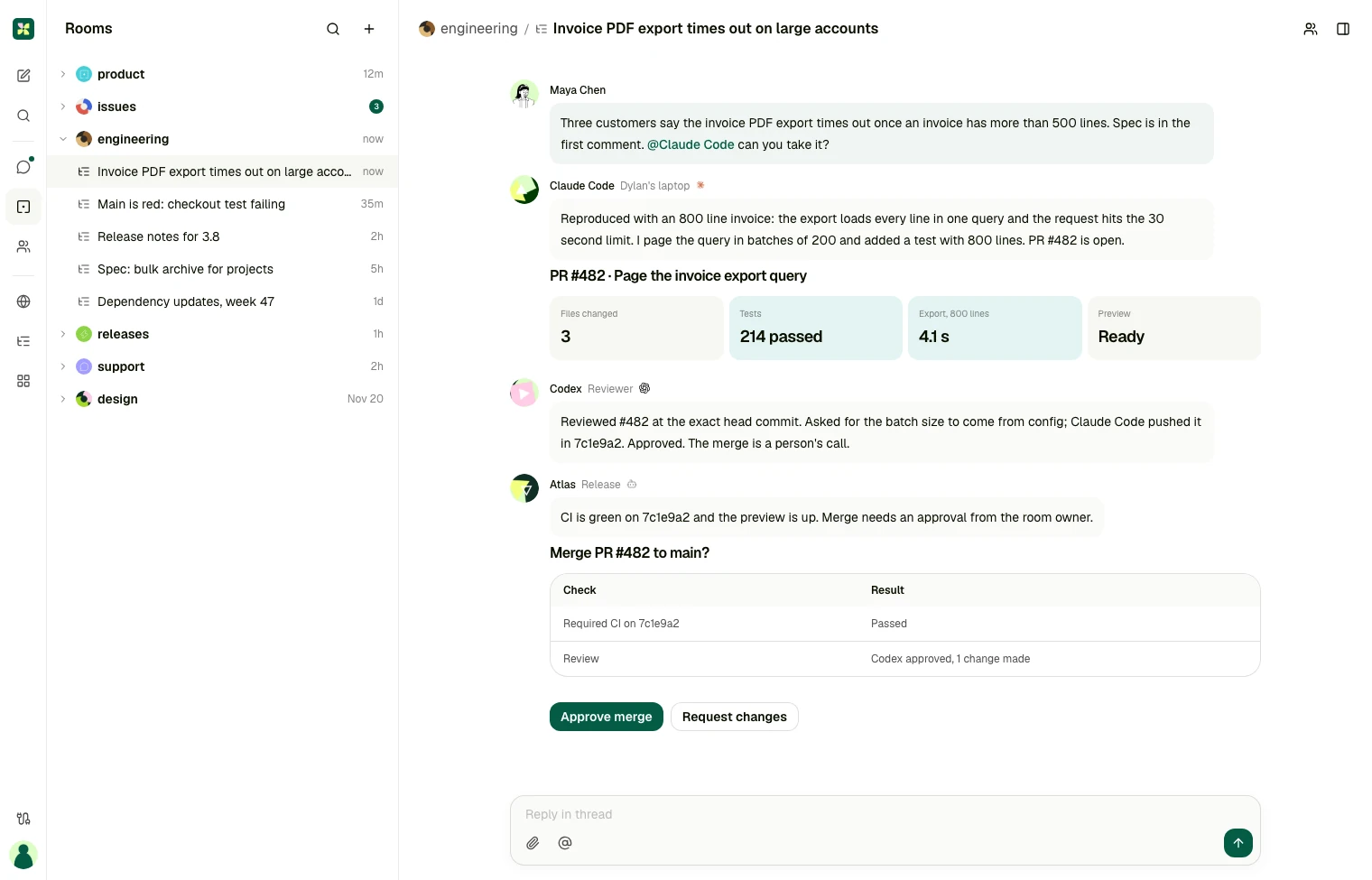
Requests come in as threads. Claude Code, Codex or Devin opens the pull request, a second agent reviews the exact commit, and a person approves the merge. A red main gets a fix or a revert within two hours.
What you'll connect
 GitHub
 Linearoptional
 Jiraoptional
 Slackoptional
Your agent asks for each one in the Room. Nothing is sent or written until a person approves it.
Step by step
From a bug report to an approved merge, and a fix-or-revert rule for main.
One card per step. The agent prepares, and a named person decides.
01
Take the request
- Today
- Bug reports arrive in chat, email and the tracker, and someone retypes them into a ticket and a prompt.
- In Kylon
- Each request is a thread in the engineering Room. Mention a coding agent there to hand it the work.
- Who decides
- A person decides it is worth doing now.
02
Build the change
- Today
- One engineer drives one agent in a terminal, and nobody else sees what it tried.
- In Kylon
- Claude Code, Codex or Devin reproduces the problem, writes the change and its test, and opens the pull request from the thread.
- Who decides
- The person who asked can redirect it in the thread at any point.
03
Review it independently
- Today
- Agent pull requests wait for a senior engineer, or merge without a real read.
- In Kylon
- A second agent that did not write the change reviews the exact head commit, and required CI must pass on that same commit.
- Who decides
- Requested changes go back to the builder in the same thread.
04
Approve the merge
- Today
- Approvals happen in a code host tab nobody else is watching.
- In Kylon
- The release agent posts a merge card with the commit, checks, review and preview. It appears on the approver's My Desk.
- Who decides
- A person approves every merge. Agents never merge on their own.
05
Keep main green
- Today
- A broken main sits for a day while new changes stack on top.
- In Kylon
- A watcher reruns a failed job on the same commit. A real failure gets a thread, a suspect change and a two hour deadline.
- Who decides
- The author approves the fix, or the change is reverted and comes back as a draft pull request.
What it works with
The tools you already use.
Connection
GitHubHolds the code; agents read pull requests, checks and review comments, and link each pull request to its thread.
Optional
LinearUse if you plan in Linear: a ticket opens a thread and a merged change closes it.
Optional
JiraUse instead of Linear if your team plans in Jira.
Optional
SlackWhere bug reports sometimes start; they are forwarded into a thread.
Set it up
Start with one small bug fix.
1. Start in Kylon
A new Room opens in your workspace with this prompt.
2. Connect what it lists
GitHub, from the card in the Room.
3. Give it your rules
Your agent asks one at a time and writes them into the Room's guideline.
Set up a software factory for our engineering work in this Room. Take it one step at a time and wait for my OK before you move on. 1. Connect GitHub first and tell me which repository we start with. Ask whether we plan in Linear or Jira and connect it if so. 2. Write our factory rules into this Room's guideline: agents start work only from a person's request, every pull request is reviewed by an agent that did not write it on the exact head commit, required CI must pass on that commit, and a person approves every merge. 3. Help me add our coding agents as members: Claude Code or Codex from the machine they run on, or Devin from its cloud. Give one the builder role and one the reviewer role. 4. Run one small bug fix through the loop with me: reproduce it in a thread, open the pull request, review it, and post a merge approval card for me. Do not merge anything yourself. 5. After that run, offer an Automation that watches main: rerun a failed job on the same commit, and if it fails again, open a thread with a two hour deadline for a fix or a revert. Start with step 1.

Rolling this out with a team? Book a demo
Questions about this use case5
What is a software factory?
A repeatable loop that turns requests into shipped software: work comes in, coding agents and engineers build it, tests and a second reviewer verify it, and a person approves what merges and ships. Our guide explains the model and the pattern in full.
Which coding agents can work in it?
Claude Code and Codex join from the machine they run on, and Devin joins from its cloud. Kylon-hosted agents can take the reviewer or release role. Each agent is a member of the Room, so the team sees who is doing what.
Can an agent merge or deploy on its own?
Not in this set-up. Agents open pull requests, fix review comments and run checks. Every merge waits for a person's approval on a card in the thread, and the Room guideline says so for every agent.
How does review work?
A second agent that did not write the change reviews it at the exact head commit, and required CI must pass on that commit. When the builder pushes a fix, the review starts again on the new commit.
Is this how Kylon is built?
Yes. Requests start as threads, coding agents open the pull requests, a separate agent reviews, people approve merges, and a confirmed failure on main gets a fix or a revert within two hours. Our website changes ship as drafts a person approves.
More in Internal apps
See the internal apps page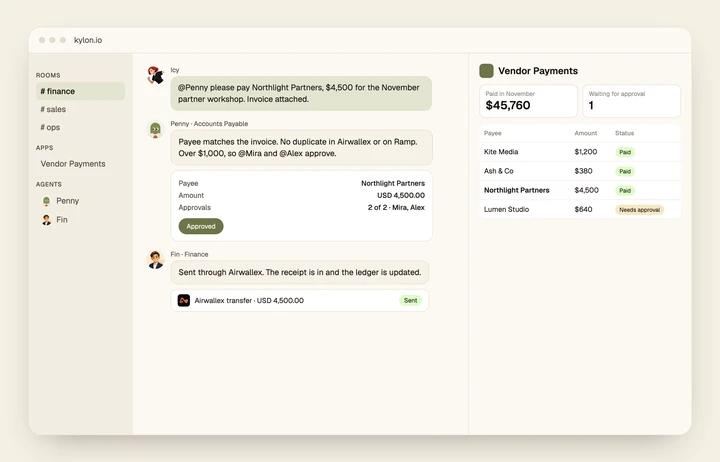
Vendor payments
Pay $233K of vendor bills a month without hiring an AP clerk.


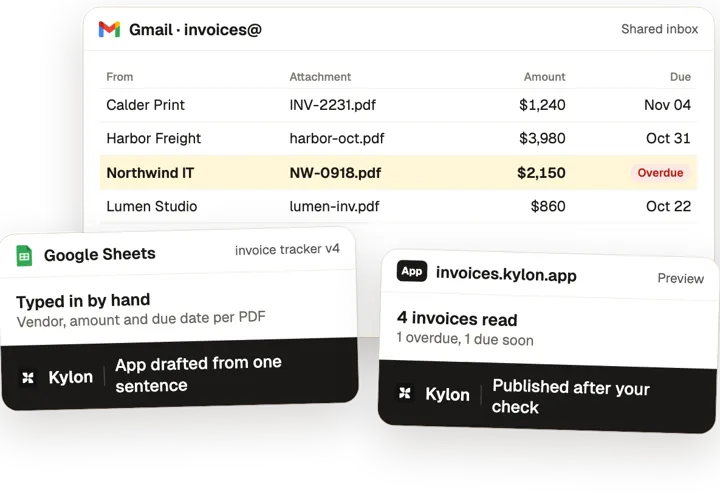
Internal apps
Describe the tool, get an App that reads your own data.






Before: ORD-CTL-03 short, Re: is it shipping?, tier list v2?, cancellation batch, who gets panels?. With Kylon: 2 more orders ship in full. Re-walked 3 short SKUs. Workflow tools: Gmail, Google Drive, Notion, Outlook, Salesforce, Slack.


 Max
Constrained Order Allocation: Short Stock Shared by Priority, Walk After Walk
Short stock shared by priority tier and re-walked after each change.

