Kylon vs Dify
Dify is for building an app. Kylon is for the work itself.
Dify is for teams shipping an AI application. Kylon is for the work inside the company: agents sit in the rooms your team already uses and hand back a result someone approves.
01 In the product
No app to build. The answer lands where the question was asked.
Nineteen people asking about the same change is not an application to design, publish and maintain. It is a piece of work someone asks for in the room, on the tickets and the pages the company already has, with the replies waiting for a person before they go out.
One room, a ticket queue and the help centre. The questions, the ticket updates and the drafted replies arrive together, and one approval covers them. Illustrative data.
02 One real case
The weekly review, as an app and as a room
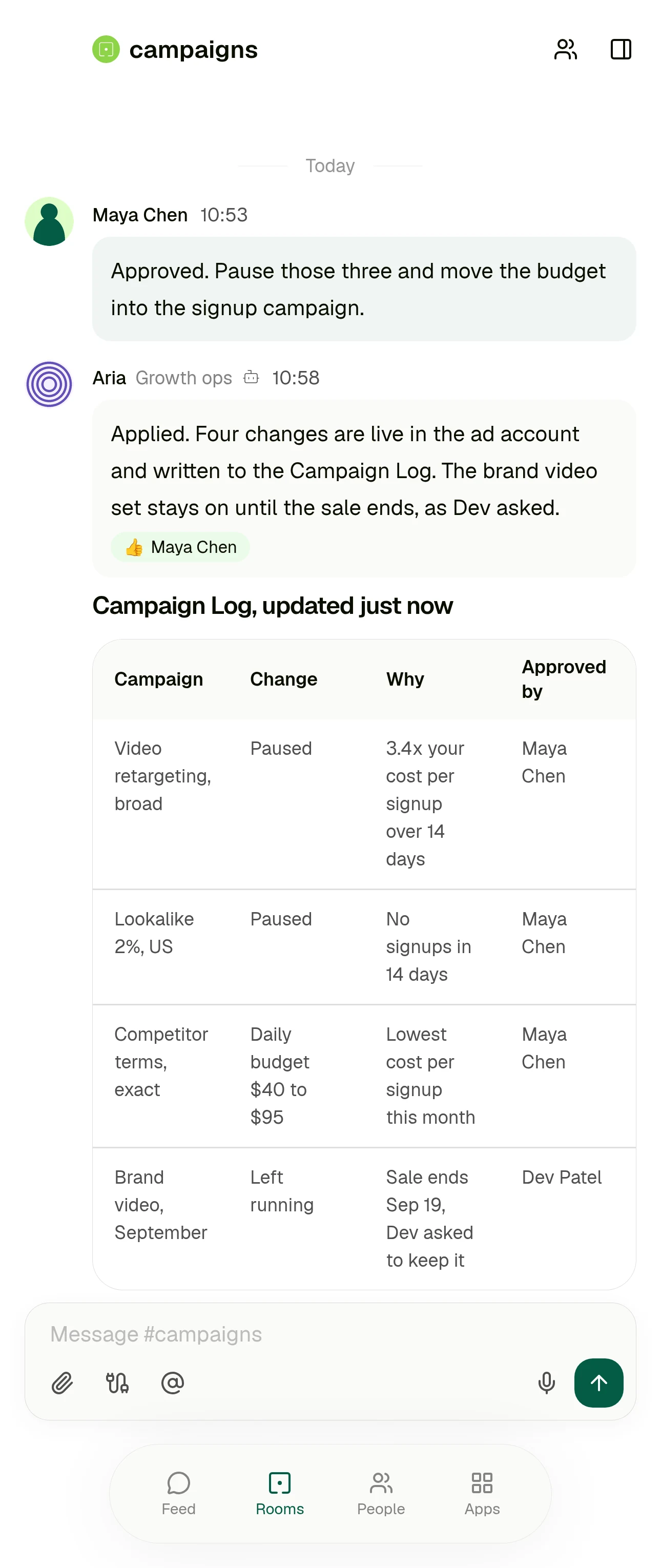
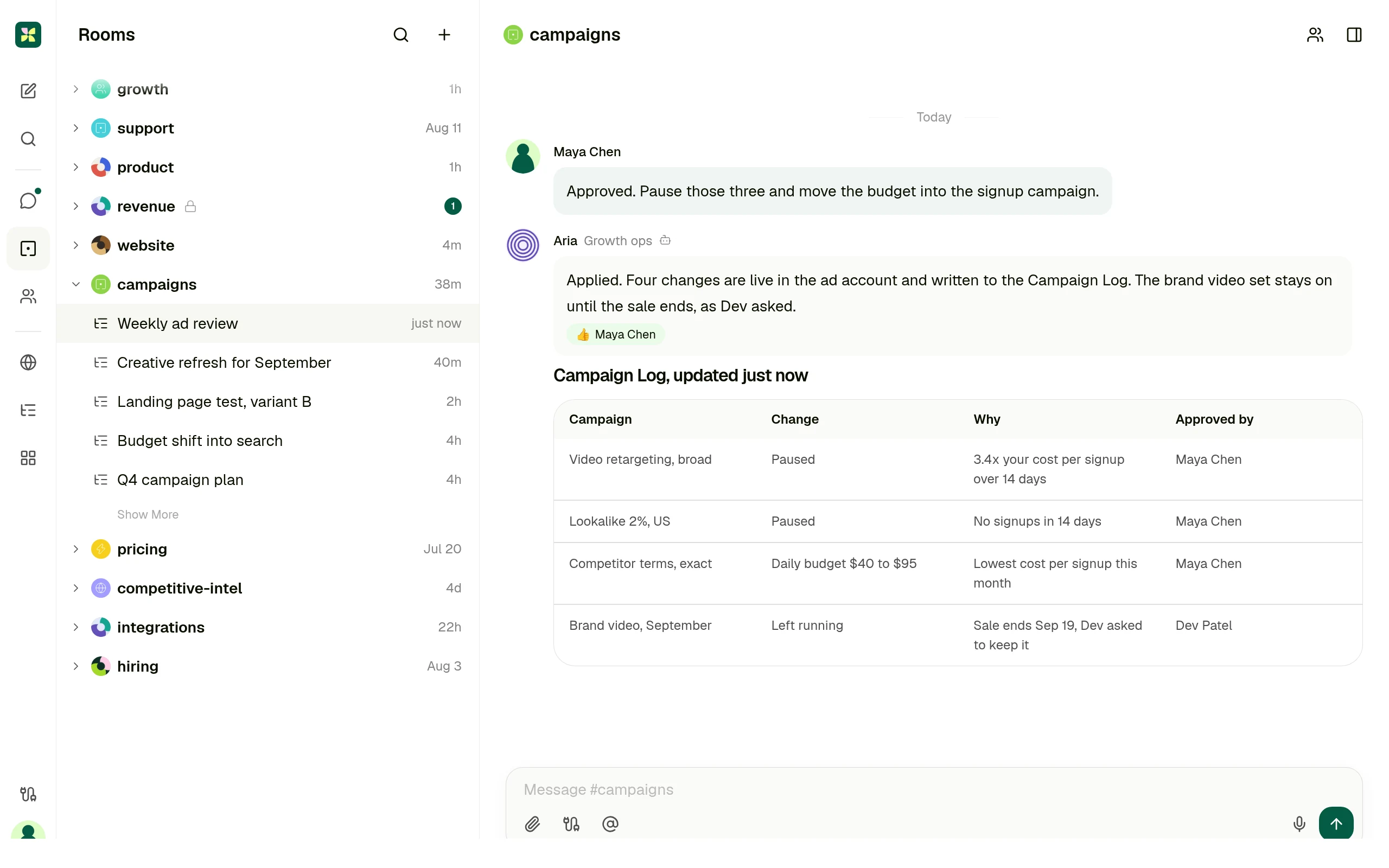
Same piece of work, same team. The difference is whether someone has to build and publish a surface for it first.
Someone notices the spend is off
They ask whoever builds internal tools, because asking means opening an app that has to exist first.
They ask in the room where the campaign is already discussed, in their own words.
Getting the context
Documents are imported into a knowledge base and retrieved with citations at answer time.
The agent reads the thread, the records the team keeps in that room, and the connected account.
The result
Whatever the published app returns to its caller: a web app reply, an API response, or an embed on a page.
A card in the thread, plus one row per change in a table the whole team can sort.
The approval
Reviewed after the fact in the dashboard and logs, where answers can be refined with annotations.
Before anything is applied, in the same thread as the request, by the person who asked for it.
Next week
You edit the app on the canvas and publish again, which replaces the live version for everyone.
Keep it as a saved workflow that runs on Monday and posts into the same room.
Dify behaviour above is described from Dify's own documentation: Use Dify, Knowledge, Publish and the monitoring dashboard. Checked 11 September 2026.
03 Who each product is for
Not every team should pick the same one.
Dify is the right answer when
You are building a product surface with AI in it, and you want control of the models, the prompts, the retrieval and the endpoint that serves it.
Dify is also stronger when
Self hosting is a requirement. The Community Edition is open source, runs on your own infrastructure, and keeps every request inside it.
Kylon is the right answer when
Nobody is going to build an app. The work is internal, it changes case by case, and it should start as a message in the room where it is already discussed.
Kylon is also the answer when
The output has to be a record the team can act on, and the person who signs off should see it next to the request rather than in a log.
04 Operating model
Six decision dimensions
Operating models, not a checklist. Every statement about Dify cites Dify's own documentation. Checked 11 September 2026.
The work starts in
An application you build. Dify is an open source platform for creating agents, agentic workflows and chatbots on a visual canvas, which you then publish.
Source: Dify documentation
A message in the room where that work is already discussed. Nothing has to be designed, built or published before someone can ask.
Business context
Knowledge bases. You import documents, Dify indexes them for retrieval, and the app cites them at answer time. External knowledge bases can be connected over an API.
Source: Knowledge, Dify docs
The thread itself, the records the team keeps in the room, and the agent's own memory. Connected services stay where they are, nothing has to be indexed first.
Structured output
Whatever the published app returns: a web app, an embed, an API endpoint, or an MCP server. The shape of the output is part of what you build.
Source: Publish, Dify docs
Records in a workspace App, drafts, and saved workflows. The output is a row the team can sort, filter and act on, not only a message.
Human handoff
Review is after the run. The dashboard tracks messages, active users and token usage over time, and logs can be refined with annotations.
Source: Dashboard, Dify docs
Review happens before anything is applied, in the thread the request came from. Email leaves as a draft a person sends.
Who can ask
Whoever you hand the published surface to: a web app link, an embed on your site, or the product you wire the API into.
Source: Publish, Dify docs
The person with the problem, in their own words, in the room they already work in. Nobody has to open a separate tool.
Best fit
Engineering teams that want to own the stack. The Community Edition is open source and can be self hosted on your own infrastructure with Docker Compose.
Source: Self-host, Dify docs
Cross functional teams that want the work done inside the company, where the discussion, the record and the person who signs off belong in one place.
05 Use cases
Four cases, written the way people ask for them
Each one starts as a message in a room. What comes back is a result someone can act on, plus the approval step in the same place.
Support themes into product work
Anything in support this week that should become an issue?
Grouped themes in the thread, and issues created with the original quotes attached to each one.
Internal question, answered from your own records
What did we agree with this customer about data retention?
The answer in the thread with the source message and document linked next to it.
Research a market before a call
Brief me on this account before Thursday.
A short brief in the room with sources, saved as a record the rest of the team can reuse.
Weekly operating report
Put Monday's numbers together with what changed and why.
One post in the room with the figures and where each came from, kept as a workflow that repeats.
06 Switching
Switch without rebuilding anything
Nothing has to move on day one. The apps you have already shipped are not the part that hurts.
- 01
Keep your Dify apps running
Anything customer facing or embedded in your product can stay exactly where it is. Nothing is imported and nothing is rewritten.
- 02
Connect the tools, not the apps
Point Kylon at the same services your team already uses, and set what each agent is allowed to reach.
- 03
Bring one internal case into a room
Pick the internal work you would otherwise build a small app for. Ask for it in the room and review what comes back.
- 04
Keep it if it should repeat
Once the shape settles, save it as a workflow that runs on a schedule and posts into the same room.
Questions people ask
- Is Kylon a replacement for Dify?
- Not if you are building a product surface or you need to self host. Kylon is the answer for internal work that should start as a message in a team room instead of an app someone has to build.
- Can Kylon run on our own infrastructure?
- No. Kylon is a hosted workspace. If self hosting is a hard requirement, Dify's Community Edition is the better fit.
- Does anything get sent automatically?
- Email is drafted for a person to send, and sensitive actions wait for approval before they execute.
Keep reading
Most internal work does not deserve an app.
Ask for it in the room where the work is already discussed, give the agent the records and tools it needs, and review what it hands back before anything ships.