tl;dv Meeting Notes to CRM and Issue Tracking: A Practical Kylon Workflow
Use tl;dv transcripts and notes to propose CRM updates, turn delivery blockers into issues, and keep every action tied to its source meeting.
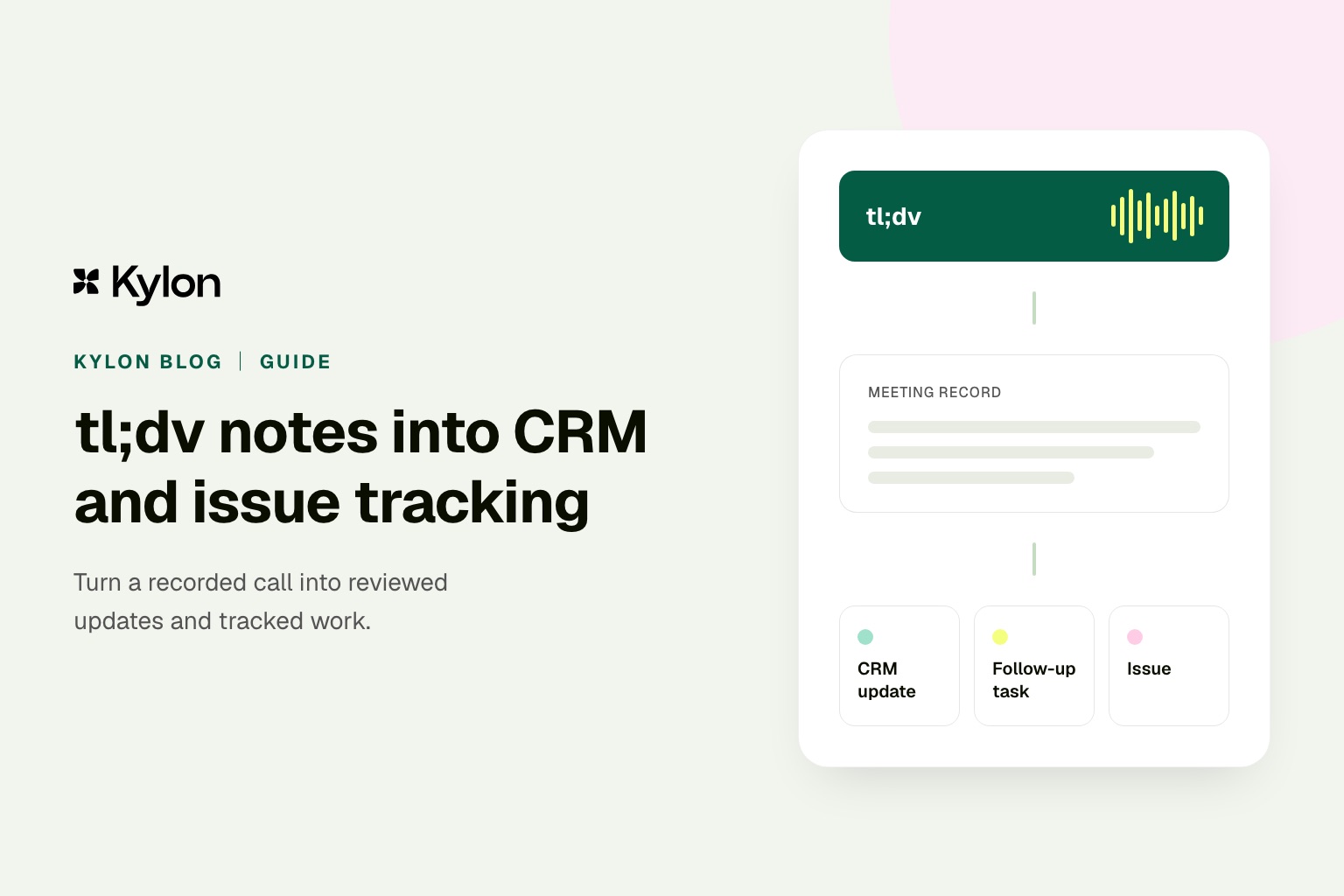
A sales call, implementation review, or customer interview often leaves three separate trails: the recording in one tool, the customer context in the CRM, and delivery work in an issue tracker. The handoff between those systems determines whether the meeting creates momentum or more follow-up work.
The tl;dv API can retrieve meetings, transcripts, and notes, and its webhook documentation describes notifications when a meeting or transcript is ready. tl;dv API guide tl;dv webhook guide
This article lays out a Kylon pattern that uses those events to prepare CRM and issue-table updates for review. It is designed for teams that want the context from a call to become shared work, not an isolated meeting recap.
The workflow in one view
- tl;dv finishes processing a meeting.
- A MeetingReady or TranscriptReady event starts an intake process. tl;dv webhook events
- Kylon retrieves the meeting context, transcript, and generated notes through the API.
- The agent prepares a structured summary and proposes where each fact belongs.
- An account owner reviews CRM updates. Product and delivery owners review issue records.
- The final records retain the original meeting as their source.
Why this is different from sending a summary to Slack
A summary in a channel is useful for awareness, but it does not solve three operational questions:
- Which CRM record should carry this context?
- Which promise needs a named owner and date?
- Which feedback should become an issue rather than a note?
Kylon can keep the discussion, source material, proposed records, and approvals in the same work context. The team can correct a mistaken match before it changes customer data.
The records to create
CRM update proposal
Use the following fields as a minimal CRM update:
| Field | Example |
|---|---|
| Account and contact | Confirmed company, relevant attendees |
| Meeting summary | Outcomes, concerns, and requested follow-up |
| Opportunity signal | Evaluation stage, timing, or renewal context |
| Next step | Owner, due date, and customer expectation |
| Source | tl;dv meeting and transcript links |
Where your CRM supports it, tl;dv offers native field mapping for HubSpot, Salesforce, and Pipedrive. That can be useful for a stable, narrow mapping. tl;dv CRM field mapping
Use Kylon when the routing depends on context across the meeting, internal instructions, and more than one destination, such as a CRM update plus a product issue plus an internal follow-up.
Issue record proposal
A well-formed issue record should answer:
- What happened or what was requested?
- Who is affected and how important is the impact?
- Is it a bug, product request, implementation task, or risk?
- Who owns the next action?
- Which exact meeting supplied the context?
This removes the usual detective work from product or delivery teams. They can start with a concise record, then open the transcript only when deeper context is necessary.
Step-by-step setup
1. Confirm API access and ownership
tl;dv states that its API is available on Pro or Business plans and is currently v1alpha1, so teams should expect endpoint changes and keep the integration isolated behind a small connector. tl;dv API access and versioning
Create an API key only for the account and meeting scope that the workflow needs. tl;dv notes that meeting visibility in the app and API access are separate concerns, so test the account that will run the workflow with a real meeting before you rely on a shared link. tl;dv permissions
2. Subscribe to completion events
Configure a webhook endpoint to receive only the events that begin your workflow. tl;dv documents MeetingReady and TranscriptReady events and explains that webhooks can avoid repeated polling for completed meetings. tl;dv webhook configuration
For most teams, TranscriptReady is the safer trigger because it indicates that the detailed source material is available. Store the event ID and meeting ID so duplicate deliveries do not create duplicate CRM or issue records.
3. Add an extraction and routing guide in Kylon
The guide should name:
- Account matching rules and required confirmation signals
- CRM fields that can be drafted automatically
- Issue types and escalation criteria
- Words or categories that require human review
- A rule that every created record retains the source meeting link
This turns the workflow into an accountable operating process rather than a generic summarization prompt.
4. Review proposed changes in one thread
Use a compact approval step for customer records and commitments. A reviewer should be able to choose: approve, edit, send to another owner, or mark as discussion only. The review history becomes part of the context for later calls.
Common failure modes
Writing an issue for every comment. Product feedback needs a threshold. Keep low-confidence comments in the meeting summary, and create an issue only when a team can act on it.
Updating the wrong account. Use attendee domains, CRM identifiers, and an explicit confirmation when there are multiple possible matches.
Losing the source. Every structured record should retain a link to the tl;dv meeting. This is what makes the automation auditable when a summary omits nuance.
Giving a workflow blanket permissions. Limit data access to the intended meeting scope and preserve human review for sensitive account details, commercial terms, and commitments.
The next useful meeting should update work, not just notes
tl;dv already supports integrations that move meeting insights into many tools, including native CRM workflows. tl;dv integrations
Kylon adds the operating layer for cases where the same meeting needs a shared decision, an accountable task, and a durable source trail across CRM and issue tracking.
If you want the short version of what that looks like on a live tl;dv account, see Kylon for tl;dv users.
To design the fields and review step for your team, book a Kylon consultation.
Your first company harness. Where humans and agents run your business together.