PLAUD Embedded SDK to CRM and Issue Tracking: A Practical Kylon Workflow
Two ways to get PLAUD material into your workflow: connect an agent to your own recordings over MCP, or build on the Embedded SDK. Here is what each gives you, what Embedded costs, and how to turn the resulting transcripts into reviewed CRM updates and issue records.
Updated 17 September 2026: added the MCP route for connecting an agent to your own recordings, and sourced every PLAUD claim to its documentation page.
A useful meeting record is not just a summary. It needs to reach the customer record, delivery queue, and colleague who owns the next decision while the conversation is still current.
PLAUD offers two routes to that material, and they are aimed at different people.
The personal route is MCP. PLAUD MCP and the PLAUD CLI let an MCP-compatible client search your recordings, read transcripts, and work with generated notes. Both went generally available on 12 May 2026. This is configuration, not engineering, and it covers your own archive.
The product route is Plaud Embedded. It gives a builder the device SDK, the file upload API, and the transcription pipeline behind PLAUD's own apps, so your users record on PLAUD hardware inside your product. Plaud Embedded overview
This guide covers both, and the Kylon workflow that turns either source into reviewed CRM updates and issue records. The workflow keeps a person at the decision points that affect customer data, commitments, or delivery scope.
Connect your agent to PLAUD over MCP
If the recordings are yours and you want an agent working with them today, this is the whole job. No SDK, no mobile app, no credentials to manage.
PLAUD requires Node.js 20 or higher and a PLAUD account. One command detects your AI clients, writes their MCP configuration, and opens a browser to authorize (source):
npx -y @plaud-ai/mcp@latest installClaude Desktop, Claude Code, Codex Desktop, Cursor, Windsurf, VS Code, Zed and Kiro are configured automatically. Claude Web and ChatGPT Web get an interactive guide instead. The desktop clients need a full quit and reopen afterwards, not just a closed window, which is the usual reason the tools fail to appear.
Once connected, the client has seven tools (source):
| Tool | What it does |
|---|---|
login | Opens your browser for OAuth sign-in |
logout | Signs out and revokes your authorization |
get_current_user | Shows your current account details |
list_files | Lists your recordings, with optional filters |
get_file | Returns full details for a single recording |
get_note | Returns the AI-generated summary, action items, and key topics |
get_transcript | Returns the full transcript with timestamps and speaker labels |
Two limits shape how well this works. list_files matches query against the recording name, not the transcript body, so an archive full of "New Recording 12" is effectively unsearchable. And filtering scans a budget of recent recordings rather than querying the whole account, so an empty result can mean the scan never reached that date. Our Plaud MCP guide covers the full tool surface, the returned fields, and the troubleshooting table.
Doing this for a team, not one laptop
The local install connects your account to your client on your machine. That ceiling matters: when a colleague needs the same meeting, you are back to pasting a summary into a message.
In Kylon, PLAUD is a workspace connection. You authorize it once from an authorization card, and the agents you grant access to can read those recordings inside the room where the work is already being discussed. The connection exposes the four read tools, list_files, get_file, get_note and get_transcript, with no login tool needed because the connection handles authorization.
That is what makes the rest of this guide possible. A transcript that an agent can read in a shared room can become a CRM update, an issue record, and a follow-up draft that a colleague reviews in the same thread.
What Plaud Embedded gives you
The other route is for products rather than individuals.
| Component | What it does | Reference |
|---|---|---|
| iOS and Android device SDK | Scan, bind, and pair devices, start and stop recording from your own app UI, transfer files, run over-the-air firmware updates, and read battery, storage, and sync state | iOS SDK, Android SDK |
| Authentication API | Exchange a client ID and secret for a partner token, then mint a per-user token that the SDK and upload endpoints accept | Authentication APIs |
| File upload API | Push your user's audio into PLAUD storage and get back a download URL for transcription | File Upload API |
| Transcription API | Submit an audio URL, then poll the returned transcription ID until the task completes | Transcription API |
Three constraints are worth knowing before anyone scopes work, all from PLAUD's Embedded FAQ and overview:
- You need a mobile app. The SDK integrates into an iOS or Android application, which handles device pairing, recording controls, and the user experience.
- A device binds to one app. PLAUD ties each user's device to a single application, which is what makes its offline encryption work, so a stolen device stays inaccessible.
- Your users do not need a PLAUD app subscription. In the SDK model, PLAUD is infrastructure, you pay for transcription usage and connected devices, and you own the product experience and pricing.
PLAUD lists 112 supported languages for its speech models, and offers WiFi Fast Transfer as an alternative to the default BLE syncing at roughly ten times the speed. Plaud Embedded overview
What it costs
Plaud Embedded bills on two meters: connected devices and transcription hours. New developers get 50 free connected devices, and 300 free transcription hours that unlock after the first device connects. Beyond the free tier, PLAUD publishes 15 USD per device per month and 0.28 USD per transcription hour, charged at the end of the month with a seven day grace period on failed payments. Connected devices are counted as the monthly maximum, not the month-end figure. Plaud Embedded billing
For a pilot, that free tier is usually enough to prove the workflow before anyone signs a contract.
Where the audio actually sits
This is the part worth settling before you write code, because it decides which teams can adopt the result.
PLAUD documents a device-only integration, where audio stays on the device and moves to your own app and services without touching PLAUD's cloud. Both the Note Pro and the NotePin S carry 64 GB of local storage. If you do use the transcription API, transcriptions are retained for seven days by default, configurable on custom plans, and processing runs in US regions unless you arrange Japan, Europe, or Singapore hosting through PLAUD's sales team. Plaud Embedded data retention
On the MCP side the profile is different. For browser clients connecting over HTTP, PLAUD states that recording data passes through its MCP server hosted in the US and is processed in transit only, not stored after the request completes. PLAUD MCP documentation
Which route fits your case
| Question | PLAUD MCP and CLI | Plaud Embedded |
|---|---|---|
| Whose recordings | One person's own archive | Your product's users |
| What you build | A connected client that reads recordings and transcripts | A mobile app that pairs devices and calls PLAUD APIs |
| Effort | Configuration | Engineering project |
| Good for | An individual operator wiring their own meetings into a workflow | A vertical product that needs in-person conversation as first-class context |
| Reference | PLAUD MCP | Quickstart |
Choose one route based on where the data lives and who should have access. Do not place another person's meeting archive behind a shared personal credential.
The operating model
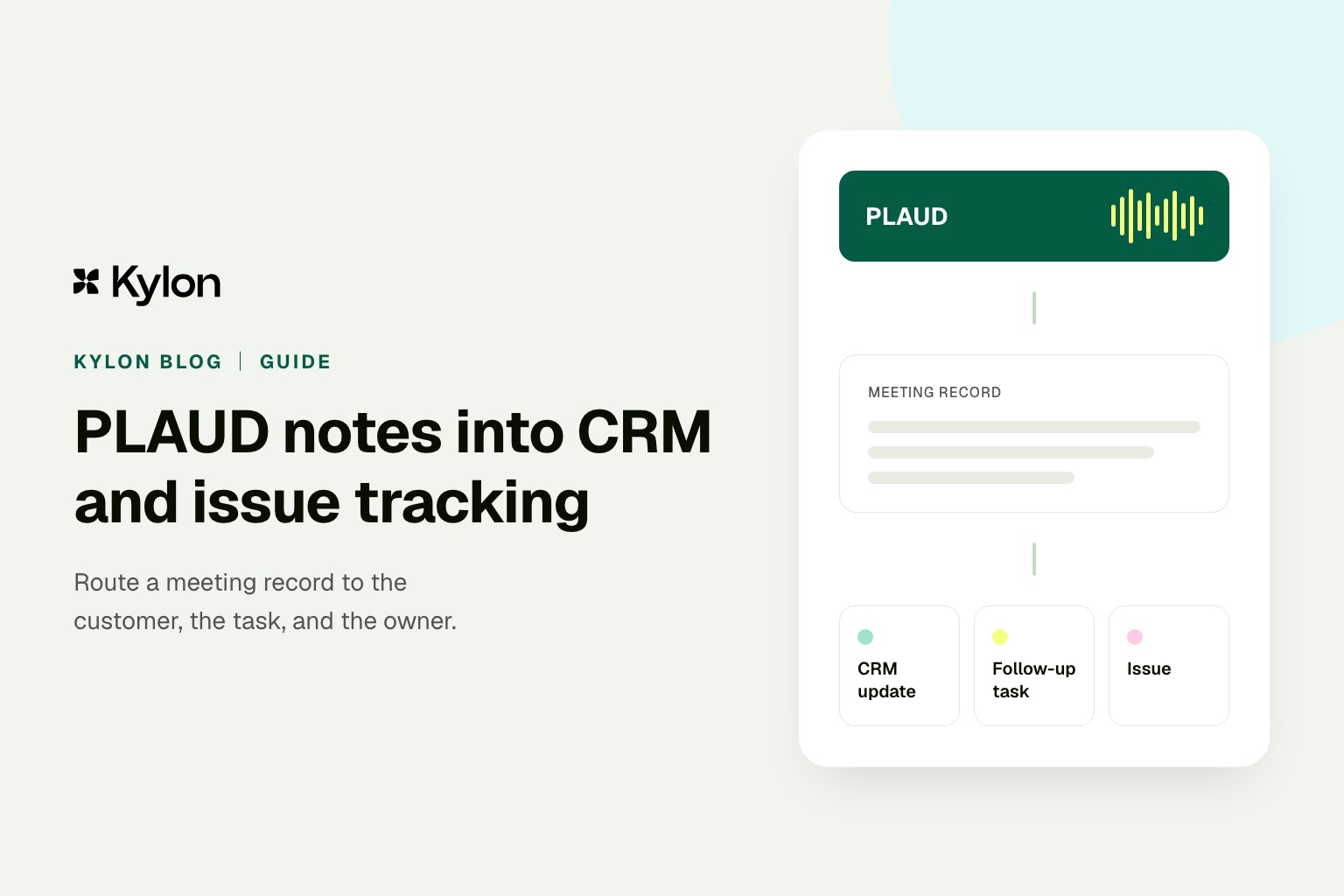
Whichever route brings the transcript in, the workflow after it has four stages:
- Bring in a completed transcript or note. A team member can request the relevant PLAUD record through the MCP path, or your own service can submit audio to the transcription API and poll the task until it reports success. PLAUD's transcription flow is a polling model, not a callback: you keep checking while the status reads
PENDING,RECEIVED,STARTED, orPROGRESS, and read the payload once it readsSUCCESS. Submit audio for transcription, Get transcription task - Extract structured facts. Kylon separates customer names, attendees, stated needs, commitments, risks, and follow-up dates from the full meeting context.
- Match before writing. The system proposes the CRM account or contact using the meeting context. It does not silently create or overwrite a customer record when a match is ambiguous.
- Route work into the correct table. Product gaps, bugs, implementation blockers, and internal requests become distinct issue records with an owner, source meeting, and review state.
The result is a shared work queue, not another folder of meeting summaries.
Because the pipeline polls rather than receives a callback, store the transcription ID against the meeting record. It is what keeps a retried poll from creating a second CRM update or a duplicate issue.
What should be extracted from every conversation
Start with a small schema that the team can review quickly:
| Field | Destination | Why it matters |
|---|---|---|
| Account, contact, and attendees | CRM | Keeps the conversation attached to the right relationship |
| Decision and confidence | CRM timeline | Makes commercial context available before the next call |
| Promise, owner, and due date | Action table | Gives each commitment a visible next step |
| Product feedback or blocker | Issue table | Separates delivery work from the customer narrative |
| Transcript and note link | Source field | Lets the team verify the original discussion |
Keep the original transcript available. A summary is an interpretation, and a teammate should be able to return to the exact wording when a decision matters.
One caution specific to PLAUD: get_file returns a presigned_url for the audio that is valid for 24 hours (source). Store the recording ID in your source field and re-resolve the link when someone needs it. A signed URL pasted into a ticket is a dead link by tomorrow.
A Kylon implementation pattern
1. Create an intake room
Create one room for meeting intake and specify what the agent should extract. The instructions should define the team's customer identifiers, which issue types matter, and the cases that require human review. Examples include a new commercial promise, a renewal signal, a security request, or a delivery date.
2. Connect the PLAUD source
For a personal working archive, authorize the PLAUD connection and let your agent search recordings, retrieve transcripts, and read generated notes directly in the room.
For a product integration, start from PLAUD's quickstart: create an Embedded SDK application in the developer portal to get your client ID and secret, generate an API key for the transcription API, then add the SDK to your iOS or Android app. PLAUD also ships an iOS starter app and an agent skill you can install with npx skills add Plaud-AI/plaud-embedded-skills if you want a coding agent to walk the integration with you.
3. Propose CRM changes, then review them
The agent drafts a compact update under the matching account:
- Meeting date and attendees
- Customer goals and unresolved questions
- Commercial or delivery signal
- Proposed next action and owner
- Link back to the transcript or note
A sales or customer-success owner can approve, edit, or decline the proposed update in the same thread. This is safer than treating every detected fact as a final CRM value.
4. Create issue records only for actionable work
An issue record should include a short title, type, impact, customer or account, accountable owner, and the source meeting. The transcript link gives product and delivery teams enough context to investigate without re-interviewing the account team.
A useful split is:
- Bug: a current behavior blocks a promised workflow
- Product request: a repeated need that requires prioritization
- Implementation task: configuration, content, or follow-up work owned by the delivery team
- Risk: an uncertainty that needs an explicit owner and decision date
A review checklist that preserves trust
Before any automated update is published, check:
- Did the system match the correct account and contact?
- Is the statement a decision, an open question, or merely a discussion point?
- Does the proposed owner know they own it?
- Does the source link point to the right meeting?
- Should sensitive details be restricted to a smaller room or record?
- Is the transcript still inside PLAUD's retention window, or has your own store become the system of record?
This takes less time than recreating a conversation after an incorrect CRM update.
When PLAUD is a strong fit
PLAUD is especially useful when valuable meetings happen beyond a browser video call: onsite conversations, client visits, field interviews, or recorded voice notes. PLAUD's own examples for Embedded follow the same shape, including clinical documentation from physician and patient conversations, coaching products that need conversation as agent context, and sales platforms capturing offline meetings. Plaud Embedded overview
The important design choice is not the recorder. It is the routing rule that moves a conversation from raw transcript to accountable work.
Start with one repeatable meeting type
Begin with a single meeting category, such as customer discovery calls or weekly implementation reviews. Agree on the CRM fields and issue types first. Then run the workflow for a few meetings with review switched on, refine the extraction instructions, and only broaden the scope once the team trusts the records.
If you would like to map this workflow to your CRM and delivery process, book a Kylon consultation.
Your first company harness. Where humans and agents run your business together.