Plaud MCP: How to Connect Your Recordings to an AI Agent
Plaud MCP lets any MCP-compatible client read your recordings, transcripts, and AI notes. Here is the actual tool surface, the fields each call returns, what the install does to your machine, and where the limits are.
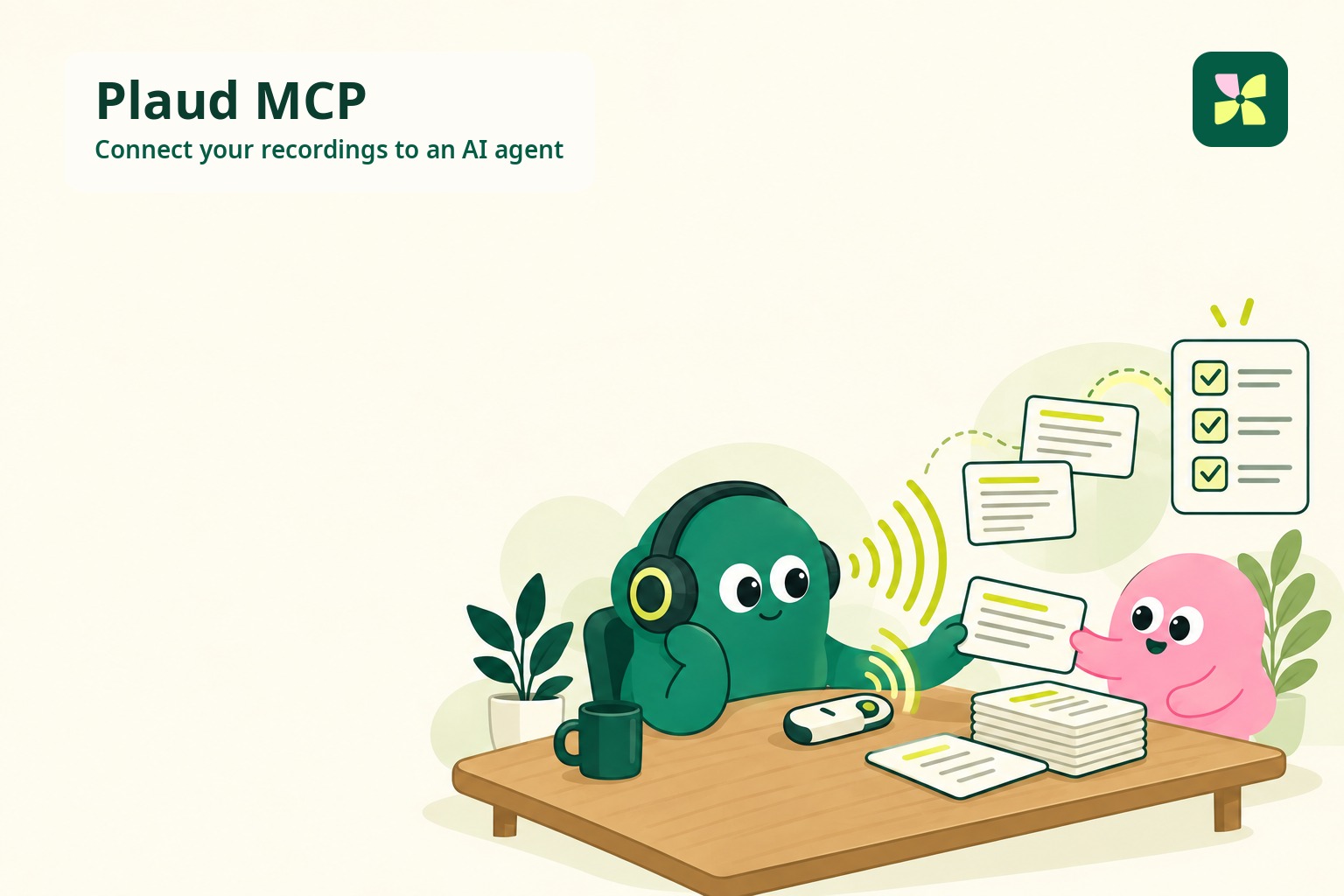
Plaud sells a recorder and the cloud that transcribes it. The gap most teams hit is the next step: the meeting is captured, summarized, and then sits in an app nobody opens while writing the follow-up.
Plaud MCP closes that gap by exposing your account to an AI client as a set of callable tools. It has been generally available since 12 May 2026, shipped as @plaud-ai/mcp alongside the @plaud-ai/cli terminal client.
This is a reference for what the connection actually gives an agent, written from Plaud's own documentation rather than the marketing page.
What it is
MCP is a client-server protocol. Plaud runs the server, your AI client is the consumer, and the tools are the contract between them. Once connected, the client can ask your account questions mid-conversation rather than waiting for you to paste a transcript in.
Plaud positions MCP as the route for extracting your own Plaud data, as distinct from Plaud Embedded, which is the SDK route for building a product on Plaud hardware. If you are evaluating the product route instead, that distinction is covered in our Plaud Embedded and CRM workflow guide.
The tool surface
Seven tools, per Plaud's MCP documentation:
| Tool | What it does |
|---|---|
login | Opens your browser for OAuth sign-in |
logout | Signs out and revokes your authorization |
get_current_user | Shows your current account details |
list_files | Lists your recordings, with optional filters |
get_file | Returns full details for a single recording |
get_note | Returns the AI-generated summary, action items, and key topics |
get_transcript | Returns the full transcript with timestamps and speaker labels |
Three of those are session management. The working surface is four calls: find recordings, open one, read its notes, read its transcript.
Worth stating plainly, because it decides whether this fits your workflow: nothing here writes. There is no documented tool to rename a recording, correct a transcript, or upload audio. Plaud MCP reads an archive that the device and the Plaud app have already produced.
Filters and pagination
list_files accepts four parameters (source):
| Parameter | Description |
|---|---|
query | Case-insensitive keyword match on recording name |
date_from | Start date, YYYY-MM-DD |
date_to | End date, YYYY-MM-DD |
page / page_size | Pagination, ignored when filters are set |
Two details matter more than they look.
The match is on the recording name only, not the transcript body. If your recordings are named "New Recording 14", search will not find the meeting where pricing came up. Naming discipline is what makes this connection useful.
Filtering is also a scan, not a query. The equivalent Plaud CLI search scans up to the 500 most recent recordings, and the same budget applies here. An empty result for last March may mean the scan never reached March, not that nothing matched. Check how far back the scan went before treating a result as exhaustive.
What comes back
list_files and get_file both return these fields (source):
| Field | Type | Description |
|---|---|---|
id | string | Unique recording ID |
name | string | Recording name |
created_at | string | Creation time (ISO 8601) |
start_at | string | Recording start time (ISO 8601) |
duration | number | Duration in milliseconds |
serial_number | string | Device serial number |
get_file adds three more:
| Field | Type | Description |
|---|---|---|
presigned_url | string | Temporary audio download URL, valid 24 hours |
source_list | array | Transcript segments with timestamps and speaker labels |
note_list | array | AI-generated notes in Markdown |
presigned_url is the one to plan around. It is a signed link with a 24 hour life, which makes it fine for an agent to fetch audio during a task and wrong to paste into a ticket as a permanent reference. Store the recording id instead and re-resolve the URL when you need it.
Installing it
Prerequisites are Node.js 20 or higher and a Plaud account (source). One command detects your clients, writes their MCP configuration, and opens a browser to authorize:
npx -y @plaud-ai/mcp@latest installTwo flags are worth knowing: --yes configures every detected local client without prompting, and --no-login skips the browser step, which is what you want on a headless or remote machine.
Which clients are handled automatically, and what each needs afterwards:
| Client | Auto-configured | Restart after install |
|---|---|---|
| Claude Desktop | Yes | Quit and reopen |
| Claude Code | Yes | Exit, then start a new claude session |
| Codex Desktop | Yes | Quit and reopen |
| Cursor, Windsurf, VS Code, Zed | Yes | Reload per client UI |
| Claude Web, ChatGPT Web | Interactive guide | No restart needed |
| Kiro | Yes | No restart needed |
A full restart is genuinely required for the desktop clients. Closing the window is not the same as quitting the app, and this is the most common reason the tools do not show up.
For a client the installer does not detect, the manual configuration is:
{
  "mcpServers": {
    "plaud": {
      "command": "npx",
      "args": ["-y", "@plaud-ai/mcp@latest"]
    }
  }
}
Skills that ship with it
The installer also loads six prewritten instruction sets, so common phrasings map to the right sequence of calls without you describing the workflow each time (source):
| Skill | Triggered by asking for |
|---|---|
plaud-browse | "list my recordings", "show recent files" |
plaud-find | "find the Weekly Sync", "the meeting from Monday" |
plaud-read | "show the transcript", "summarize this recording" |
plaud-digest | "weekly report", "what meetings did I have this week" |
plaud-followup | "draft a follow-up email", "list the action items" |
plaud-export | "save to Notion", "post to Slack" |
Where the data goes
For browser clients connecting over HTTP, Plaud states that recording data passes through its MCP server hosted in the US, and that Plaud does not store this data after the request completes, processing it in transit only, governed by Plaud's privacy policy (source).
If your recordings include client conversations, clinical discussions, or anything with a residency obligation, settle this before rollout rather than after. The local install path keeps the transport between your machine and Plaud, which is a different profile from the hosted HTTP path.
MCP or the CLI
Both read the same account. They suit different jobs.
| Plaud MCP | Plaud CLI | |
|---|---|---|
| Shape | Tools an AI client calls mid-conversation | Commands you run in a terminal |
| Install | npx -y @plaud-ai/mcp@latest install | npm install -g @plaud-ai/cli |
| Good for | "Summarize Tuesday's standup and draft the follow-up" | Batch export, scripting, piping to a file |
| Output | Interpreted by the model | Clean stdout, errors to stderr |
The CLI is the better tool when you want determinism. It has documented exit codes (2 for auth failure, 3 for network, 4 for timeout) and keeps stdout clean for piping, which makes it scriptable in a way a conversational tool call is not.
Connecting Plaud to a shared workspace
The single-user install has a ceiling. It connects your Plaud account to your client on your machine, so the meeting context stops at your laptop. When a colleague needs the same recording, you are back to copying a summary into a message.
In Kylon, Plaud is a workspace connection rather than a local config file. You authorize it once from an authorization card, and from then on the agents you grant access to can read your recordings inside the room where the work is already being discussed.
The connection exposes four tools, matching the read surface above:
list_filesfor finding recordings, with the same name-match and 500-record scan budget, plus an explicit flag on whether the scan was exhaustiveget_filefor the full record, including the 24 hour audio URLget_notefor the notes, returning one entry per tab in the app, so the AI summary, any template tab, a saved Ask Plaud answer, and highlights come back separatelyget_transcriptfor the timestamped transcript with real speaker names, paginated by cursor, withoutline,transaction_polishandmark_memoblocks available for the outline, the polished text, and the moments flagged with the device's highlight button
There is no login tool in that list, because authorization is handled by the connection rather than by a tool call in the conversation.
What changes in practice is who can act on the recording. A transcript read in a room can become a CRM update, an issue record, and a follow-up draft that a colleague reviews in the same thread, instead of three manual copies. That routing pattern, including the review step that keeps a person on anything touching customer data, is covered in the meeting notes to CRM workflow.
When it does not show up
Plaud's troubleshooting table covers the common failures:
- Tools missing after install. A full client restart is required. For Claude Code, exit and start a new
claudesession. 401or "Not authenticated". Ask the client "log me into Plaud".- Token refresh errors. Delete
~/.plaud/tokens-mcp.jsonand sign in again. - Browser does not open during sign-in. Copy the printed URL and open it manually. On a remote machine, forward port 8199 first with
ssh -L 8199:localhost:8199 user@host. - "Server disconnected" in Claude Desktop. Re-run
plaud-mcp unsetup && plaud-mcp setup, then restart.
To upgrade, run npm install -g @plaud-ai/mcp@latest and restart the client. To remove it entirely, uninstall per client, then npm uninstall -g @plaud-ai/mcp and rm -rf ~/.plaud.
Start with the naming problem
The connection works on day one. What limits its usefulness is almost never the protocol, it is that list_files matches on recording names and half the archive is called "New Recording".
Name recordings the way you would search for them, with the counterpart and the subject, and the difference in what an agent can retrieve is immediate.
If you want meeting context to reach the customer record and the delivery queue rather than stopping at one person's client, book a Kylon consultation.
Your first company harness. Where humans and agents run your business together.