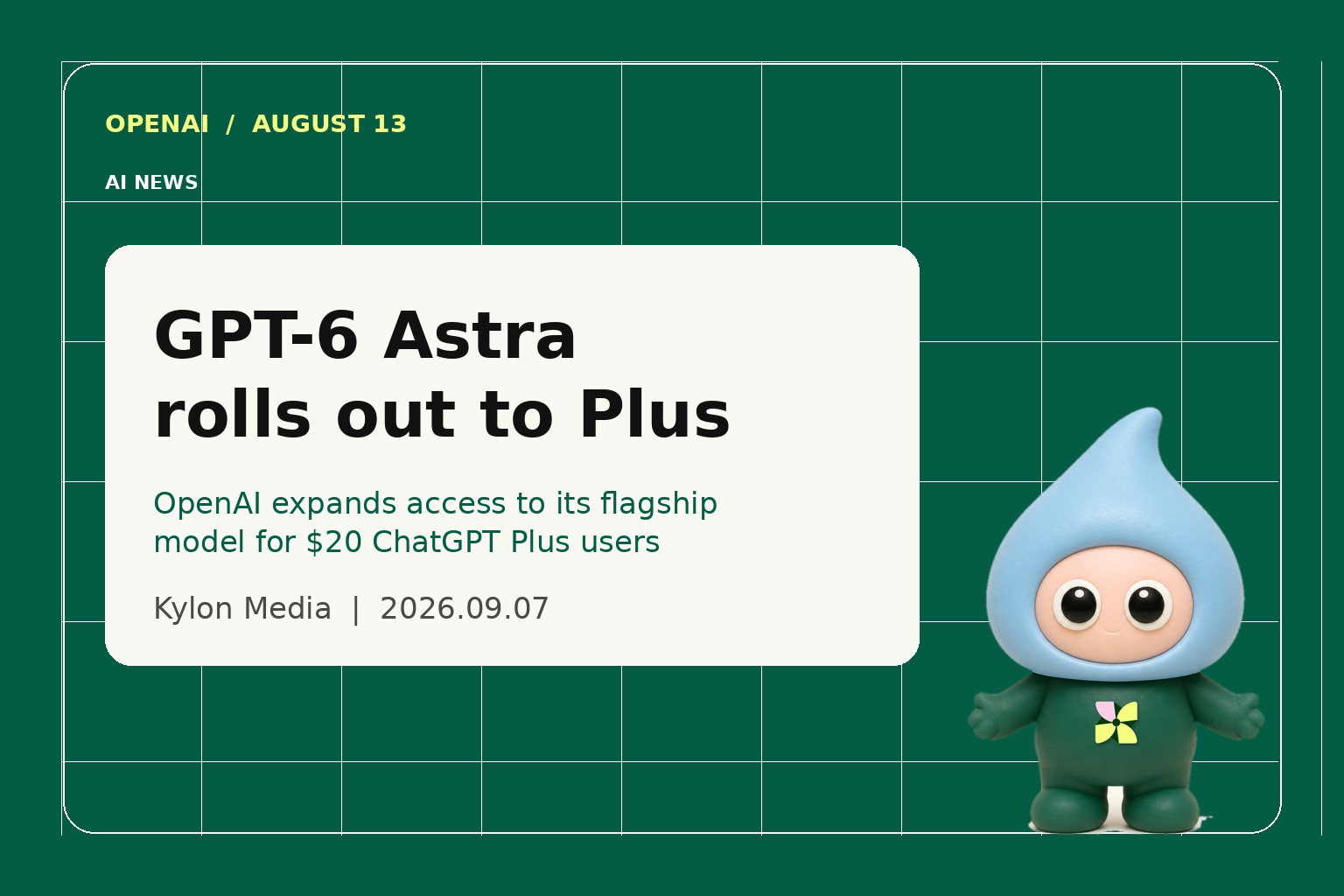
GPT-6 Astra rolls out to ChatGPT Plus: what the $20 tier gets
OpenAI is expanding GPT-6 Astra to ChatGPT Plus in a phased rollout. Here is what changes for computer use, coding, research, availability, API pricing, and teams comparing frontier models.
The short version
OpenAI is expanding GPT-6 Astra to ChatGPT Plus in a phased rollout. The $20 plan is now part of the broader access expansion announced by OpenAI, alongside Pro, Business, and Enterprise. Availability may take several days and can differ by product surface. OpenAI's launch announcement is the source for the rollout and capability details.
This is a meaningful distribution change, not a new model announcement. Astra launched on September 3 for a limited set of organizations. The latest development is that the model is moving toward a much wider paid-user audience.
What GPT-6 Astra is designed to do
OpenAI positions Astra for computer use, browsing, software engineering, cybersecurity, science, and professional work. It can fill online forms, update customer records, organize calendars, research online, draft documents, analyze data, create plots, build websites, and run frontend checks. These are capabilities described by OpenAI, not a guarantee that every workflow will perform the same way in production. Source
The model is also intended to carry context through longer work. OpenAI says Astra can adjust when requirements change, ask focused questions when a decision matters, and continue independent work in Codex while waiting for an answer when the work can proceed safely. Source
The practical change for Plus subscribers
The key change is access. OpenAI says Astra is rolling out over the coming days to ChatGPT Plus, Pro, Business, and Enterprise users. Usage is included within existing subscription allowances, with additional credits available for users and businesses that need more capacity. Enterprise administrators can enable Astra for their workspace, and access is off by default at launch. Source
Because this is staged, a Plus subscriber may see Astra in one product surface before another. OpenAI's current availability documentation says product allowances are separate across ChatGPT Work and Codex, so teams should confirm where Astra appears in their account before changing a workflow. OpenAI Help Center
API availability and pricing
Developers can use the model through the OpenAI API as gpt-6-astra, as well as through Microsoft Azure and AWS Bedrock. OpenAI lists standard API pricing of $10 per million input tokens and $50 per million output tokens. Cache reads and writes have separate rates. Fast mode is available at up to twice the speed of Standard processing for twice the Standard price. OpenAI's pricing details
These prices are not directly comparable to a ChatGPT subscription. The subscription provides product access within allowances, while API pricing applies to applications and automated workloads. Teams should measure cost per completed task, including tool calls, retries, and human review.
How Astra compares with Claude and Gemini
OpenAI's own evaluation table places GPT-6 Astra alongside Claude Fable 5.1, Claude Opus 5, and Gemini 3.8 Flash. The table reports Astra ahead of GPT-5.6 Sol on several computer-use, coding, and academic evaluations, while competitor results vary by benchmark. For example, OpenAI reports 72.6% for Astra and 65.7% for GPT-5.6 Sol on OSWorld 2.0, and 57.9% versus 55.8% for Claude Fable 5.1 on Terminal-Bench 4.0. These are vendor-published figures and should be validated with representative tasks before procurement decisions. Benchmark table
The useful comparison is task-level rather than a single leaderboard position:
- Computer use: Astra is positioned for browser and desktop actions, while teams should test permissions, recovery, and review paths.
- Coding: Astra, Claude Fable 5.1, and Gemini 3.8 Flash all target software engineering, but toolchains and pricing differ.
- Long-running work: Astra emphasizes context continuity and Codex workflows. Other models may be a better fit where a team already has a mature tool or cloud integration.
- Safety and governance: Astra includes additional monitoring and production safeguards, while enterprise teams still need their own access controls and approval rules.
Why this matters for AI-native workspaces
The distribution shift makes model choice easier to revisit, but it does not remove the operational work around agents. A team still needs a visible request, source context, permission boundary, tool connection, approval path, and completed artifact. Those pieces determine whether a model upgrade becomes a reliable workflow or just a faster demo.
Kylon is designed for that surrounding work. Teams can keep channels, agents, connections, files, skills, and recurring workflows in one workspace, then change the model used for a step without losing the context and review trail around it.
What teams should test first
Before moving a production workflow to Astra, test a small set of representative tasks:
- Can the model complete the task without access beyond the intended scope?
- Does it pause for human input when the next action is consequential?
- How often does it recover from a failed tool call or an unfamiliar screen?
- What is the cost per completed task after retries and review?
- Can another teammate understand what happened from the saved context and output?
This checklist matters more than a headline benchmark for workflows that touch customer records, financial data, code repositories, or external communications.
Bottom line
- GPT-6 Astra is moving from limited access toward ChatGPT Plus, Pro, Business, and Enterprise users. OpenAI
- The Plus rollout is phased, and availability can differ across product surfaces. OpenAI Help Center
- The API is listed at $10 per million input tokens and $50 per million output tokens, with separate cache rates. OpenAI
- Teams should evaluate permissions, recovery, cost per completed task, and human review alongside model quality.
For the full capability and availability details, read OpenAI's GPT-6 Astra announcement.
Your first company harness. Where humans and agents run your business together.