Kylon vs. Genspark: A room-first workspace for human and agent teams
Genspark offers a broad suite for agent-led creation and business tasks. Kylon centers humans, agents, context, Apps, and workflows in shared Rooms where team work accumulates.
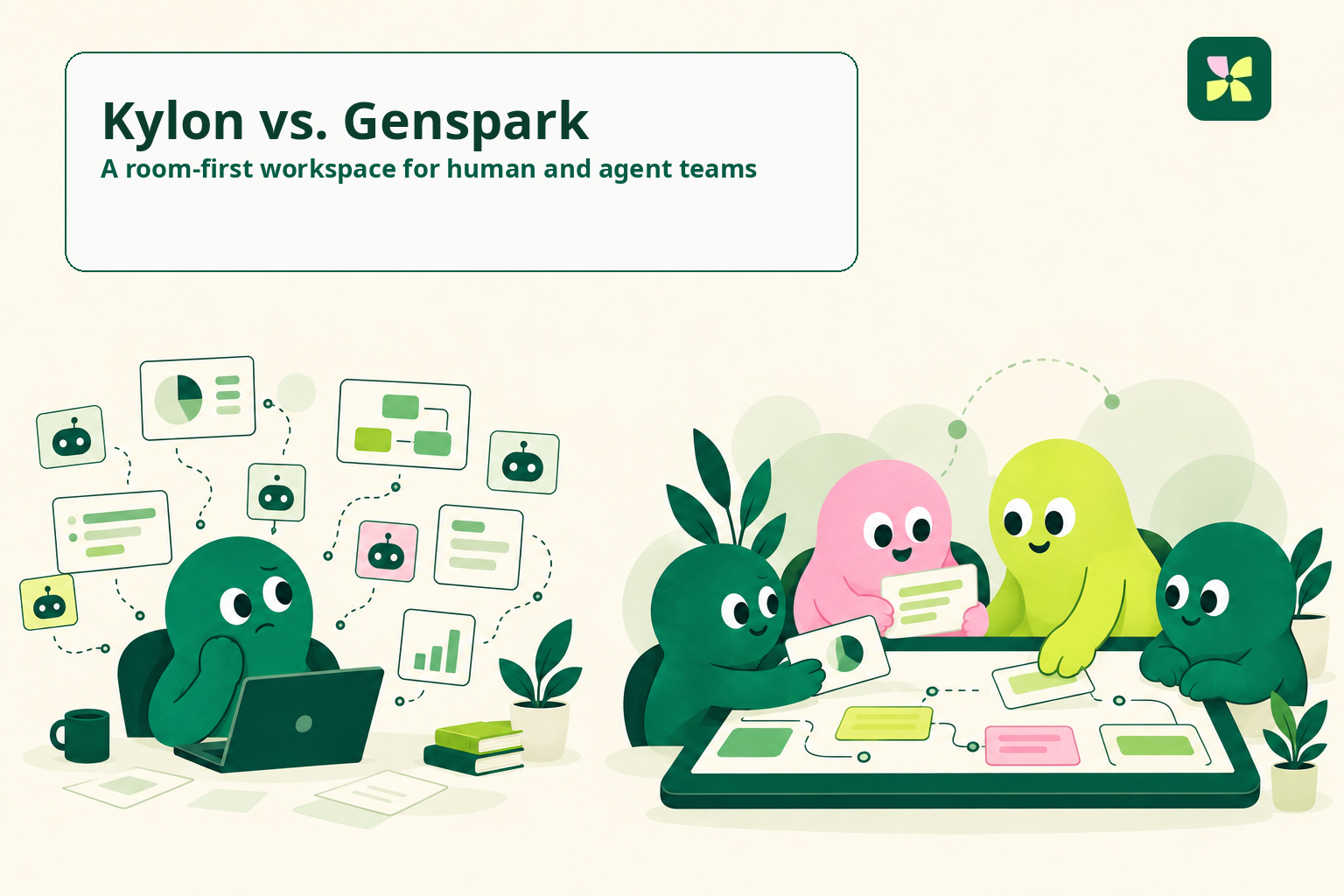
Searching for a Genspark alternative now means comparing more than two chat interfaces. The real question is how each product organizes ongoing work after the first prompt, especially when several people and agents need to contribute.
Genspark describes its current product as an all-in-one AI workspace spanning office, content, and building tools. Its surface now includes Super Agent, SecondBrain, Hubs, GenTeam, AgentBase, and Workflows. This description was checked on 2026-09-15.
Kylon starts with a shared Room staffed by human colleagues and several named agents. Each agent can have its own role, memory, and skills. Threads preserve the work, Apps hold the records it produces, connections let agents act in real tools under named accounts, and scheduled or event-triggered workflows keep the process moving. Human approval can remain the gate before anything goes out.
This is not a comparison between a capable product and an incapable one. It is a comparison between two ways of structuring agent work. Genspark presents a suite of specialized surfaces. Kylon makes the shared Room the place where conversation, execution, structured state, and follow-up meet.
Two AI workspaces with different centers
Genspark presents its workspace in four layers: SecondBrain for memory, Super Agent as the intelligence engine, creation and business-system suites as tools, and GenTeam as the collaboration layer. Its Hub feature groups projects with shared files, instructions, and cross-project context. Both points were checked on 2026-09-15.
That organization gives users several containers for different kinds of work. A task may begin in a Super Agent project, related projects may sit in a Hub, a persistent business system may live in AgentBase, automation may live in Workflows, and collaborative discussion may happen in GenTeam.
Kylon organizes the workspace around durable Rooms. A Room can contain the people responsible, named specialist agents, focused threads, files, structured Apps, and running workflows. Connections authorize action in outside services, skills encode the team's method, and each agent's memory carries relevant operating context forward. After an initial result, the team can review it, update a record, approve the next action, and assign follow-up without leaving that context.
Autonomous execution and shared continuation
Genspark defines Super Agent as an autonomous assistant that breaks requests into steps, selects tools, and carries tasks through to finished results. It operates in a dedicated sandbox with a browser, filesystem, and execution environment, and it can run parallel tasks within one project. These details were checked on 2026-09-15.
That model begins with delegation. The user describes the goal, and the system coordinates the tools and agent activity needed to produce the result. Working files remain available during the session, while delivered file cards stay with the project.
Kylon is designed for continuation by a group. A research agent can work in a thread, an analyst can update the App, and a human can inspect both before approving an operator agent's external action. The connection identifies the account used, while a workflow can schedule the next run or start it from an event. Because the evidence, decision, and record remain visible, the next colleague or agent can pick up the work without a manual recap.
How collaboration works
Genspark's GenTeam supports humans and agents in channels, direct messages, and threads, with shared files and a task board. Multiple agents can join a channel, message one another, share files, and participate in tasks with visible progress. Agents can have names, roles, skills, and retained context across conversations. These capabilities were checked on 2026-09-15.
That is important context for any current Kylon vs Genspark comparison. Genspark should not be characterized as only a personal research assistant. Its current product includes an explicit team collaboration surface.
In Kylon, Rooms are the core product model. The request, specialist agent work, human feedback, structured App records, approval, and recurring automation can remain attached to one operating context. Threads preserve detailed decisions. A newly involved teammate can see the evidence, inspect the live record, and understand the handoff. For a campaign review, for example, a research agent can collect evidence, an analytics agent can update the campaign App, and a marketer can approve the next action before a workflow repeats the collection step.
Memory, context, and work that accumulates
Genspark describes SecondBrain as a personal knowledge and memory system drawing from email, calendars, chat history, meetings, files, projects, and connected apps. It automatically saves past Genspark activity and can sync supported sources in the background. Projects in the same Hub can share conversation history, allowing relevant history from another project in that Hub to inform a response. These details were checked on 2026-09-15.
Kylon separates continuity into useful layers. Threads show evidence and decisions. Each agent's memory retains durable operating context. Skills preserve the method. Apps keep queryable records that humans and agents can update. Workflows handle scheduled or event-triggered execution. A new teammate can inspect the discussion and App, ask a named agent about prior choices, and continue from the current state rather than reconstructing the project.
Apps, skills, connections, and workflows
Genspark's AgentBase creates persistent business systems containing relational tables, views, dashboards, and workflows. Those systems can be shared as a whole or at the dashboard or table level with invited collaborators. Genspark also lets users teach Super Agent a process, save it as a reusable Skill, and share it with a team. These facts were checked on 2026-09-15.
Genspark documents native API and MCP connections across communication, productivity, CRM, developer, data, recruiting, operations, and finance services. Its Workflows can be built conversationally and triggered by a schedule or an incoming Gmail or Outlook email. These connector and automation details were checked on 2026-09-15.
Kylon brings these capabilities into one Room-centered process. Apps provide interfaces and structured records. Skills give each agent a repeatable procedure. Connections let agents act in real services under named authorized accounts. Workflows run on a schedule or event and return results to the Room. A human approval gate can hold the outbound step while the reviewer checks the source thread and App record.
Kylon vs Genspark at a glance
| Area | Kylon | Genspark |
|---|---|---|
| Primary work unit | A durable Room staffed by humans and named agents, with threads, files, structured Apps, and running workflows. | Work spans Super Agent projects, Hubs, GenTeam channels, AgentBase systems, and Workflows, as documented across Genspark's current workspace. Checked 2026-09-15. |
| Agent collaboration | Several named agents, each with its own memory and skills, hand work to humans and one another in visible threads. | Humans and multiple agents can collaborate in channels, threads, files, and tasks through GenTeam. Checked 2026-09-15. |
| Context | Threads preserve decisions, agent memory preserves role-specific context, and Apps preserve the live operating record. | SecondBrain provides personal context, while Hubs share files and project history across related projects through SecondBrain and Hub. Checked 2026-09-15. |
| Structured work | Apps turn conversation into shared databases and interfaces that both humans and agents inspect and update. | AgentBase provides relational tables, views, dashboards, and workflows in a persistent business system. Checked 2026-09-15. |
| Reusable methods | Skills give each named agent a reusable method that remains available across later work. | Super Agent workflows can be saved and shared as reusable Skills. Checked 2026-09-15. |
| Automation | Scheduled or event-triggered workflows continue the process in Room context, with human approval available before outbound action. | Workflows support schedules and incoming-email triggers, with test runs and run history in the workflow builder. Checked 2026-09-15. |
What Kylon is for
Kylon is for teams that want to staff a durable operating Room with human colleagues and several named agents. Give a research agent, analyst, writer, and operator distinct roles, memories, and skills. Keep their work in threads so evidence, corrections, and handoffs stay visible.
The Room can hold the whole process. An agent gathers evidence, another updates a structured App, and a human reviews the thread and approves the proposed action. A connection lets the operator act in the real service under the correct named account. A workflow schedules the follow-up or starts it when an event arrives. The next person opens the same Room, sees the current record and decision trail, and continues without rebuilding context.
This model is useful when responsibility moves between roles and when a process must outlive its first output. Apps make business state inspectable. Skills make the team's method reusable. Agent memory preserves specialist context. Workflows keep agreed work running. Approval gates keep human judgment at the point where an external action becomes real.
Kylon makes agent capability operational for a team: shared context, specialist roles, structured records, visible handoffs, continuing automation, and human control in one place.
What a team can do on day one
Create a Room for one live process, add the responsible people, and bring in named agents for research, analysis, writing, and operations. Give them the relevant skills, connect the services they need under the correct accounts, and create an App for the records they produce. Mark external actions for human approval, then schedule a workflow or attach it to an event. The first run leaves a visible thread, a structured record, and a next step another teammate can take.
Frequently asked questions
Is Kylon a Genspark alternative?
Yes, particularly for teams evaluating how humans and agents collaborate over time. Genspark currently describes an all-in-one workspace with Super Agent, SecondBrain, creation and business tools, and GenTeam. Kylon centers that work in shared Rooms with threads, Apps, skills, connections, workflows, and memory. The Genspark description was checked on 2026-09-15.
What is the main difference between Kylon and Genspark?
The main difference is workspace organization. Kylon uses Rooms as the shared operating context for discussion, agent work, structured Apps, and workflows. Genspark distributes work across connected surfaces including Super Agent projects, Hubs, GenTeam, Workflows, and AgentBase. That product description was checked on 2026-09-15.
Can Genspark support humans and multiple agents together?
Yes. GenTeam supports people and multiple agents in channels, direct messages, threads, shared files, and tasks. This was checked on 2026-09-15. The comparison is therefore about how collaboration relates to the rest of the workspace, not whether Genspark has collaboration features.
Do both products support connected services and reusable automation?
Yes. Genspark documents native API and MCP connections, and its workflow builder supports scheduled and incoming-email triggers. These details were checked on 2026-09-15. Kylon combines connections and workflows with shared Rooms, Apps, skills, and agent memory.
How does Genspark vs Manus relate to this comparison?
Genspark vs Manus is a separate product comparison. When evaluating either one against Kylon, use the same operating questions: where shared context lives, how people and agents hand work to one another, where structured records remain, how repeatable methods are encoded, and whether recurring work returns to the team's shared context. Verify each product against its current first-party documentation rather than relying on an older feature checklist.
Your first company harness. Where humans and agents run your business together.