Claude for Financial Advisors: how to run the same client meeting workflow on Kylon today
Anthropic put connectors and workflow skills around the work advisors do before and after a client meeting. The pattern is portable. Here is how to build the prep brief, the approved follow-up, and the house checklist on Kylon right now, and where Kylon stops.
What Anthropic shipped
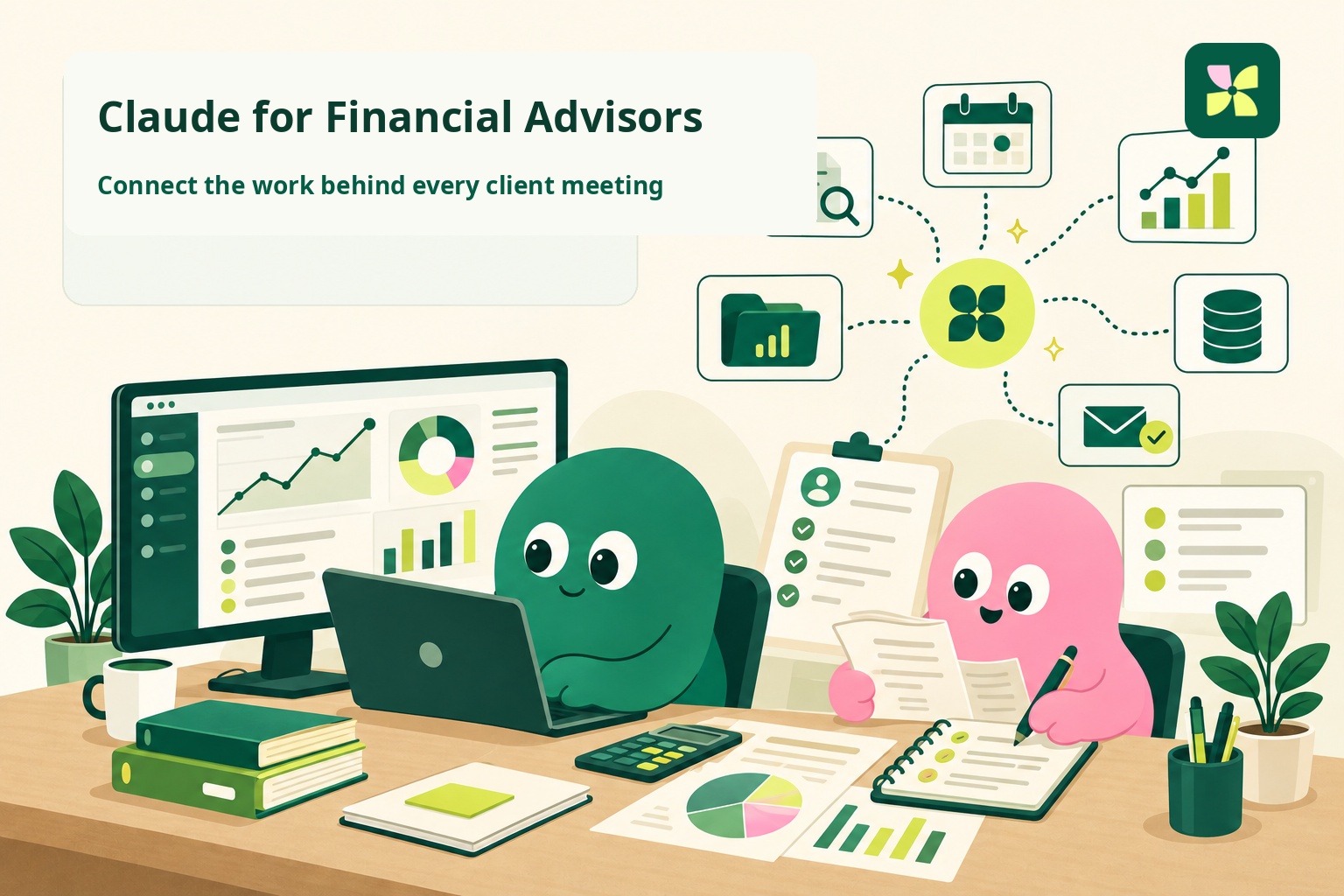
Anthropic introduced Claude for Financial Advisors, a set of connectors and workflow skills built around the work advisors do before, during, and after a client meeting. It is not a new model. It is an industry workflow layer: connectors into financial data, portfolio analytics, custody systems and CRM tools, plus named skills for onboarding, pre-meeting preparation, portfolio rebalance review, post-meeting notes, and follow-up. Anthropic's financial services page describes the connector and workflow approach, and Wealth Management reports that the advisor plugin sits on Enterprise plans with administrator audit logs and usage-based pricing.
The interesting part is not the announcement. It is the admission underneath it: the bottleneck in advisory work was never the quality of the answer. It was gathering the context before the meeting and getting the record and the follow-up out afterwards.
That pattern is portable, and most of it does not need custodial data at all. Below is how to build it on Kylon today, with the connectors that exist now, and a clear line where Kylon stops.
One room per client, so the context stops moving
The reason meeting prep is expensive is that the pieces live apart: the calendar entry, the CRM record, the last set of meeting notes, the unsigned form in a drive folder, the email thread where the client changed their mind.
On Kylon the unit is a room. You give a client, or a book of clients, its own room, and you put an agent in it as a member. The agent reads the room, keeps memory of what was decided, and reaches your tools through your own connected accounts: Google Calendar, Gmail or Outlook, Google Drive, Google Sheets, Salesforce, HubSpot or Pipedrive, DocuSign, Box, and meeting recorders including Fireflies, Granola, and tl;dv. The full list is on the Kylon integrations page.
Nothing is copied into a separate assistant. The brief is assembled where the next person will look for it.
Build one: the brief that arrives before you ask
Create a workflow on a schedule, for example every weekday at 18:00. Its job, written in plain language when you create it: read tomorrow's calendar entries, and for each client meeting, post a brief into that client's room covering the last contact, open items, the client-stated goal, and any documents added since the last meeting. Require a source line on every item.
That last instruction is the one that matters. A brief without provenance is a rumour you have to re-verify, which costs more than writing it yourself. A brief where each line names the record and its date is something you can walk into a meeting holding.
Workflows in Kylon run on a clock, on a webhook, or when a record in one of your apps changes, and every run keeps its history, so you can see what the brief was built from on any given day.
Build two: the follow-up goes out only after you approve it
After the meeting, the transcript or your notes land in the room. The agent drafts the follow-up email, the CRM update, and the list of next actions.
Outbound email from a connected account is created as a draft card in the room. You read it, edit it, and send it. The agent does not send on its own. For work that touches client communications, that boundary is the feature, not a limitation: it is the difference between an assistant that drafts and a system that speaks in your name.
Build three: your house checklist, written once
Anthropic's skills encode a firm's procedure. Kylon has the same idea, and yours are yours: a skill is a written procedure that any agent in the workspace reads on demand and follows the same way every time. Your annual review checklist, the questions you always ask before a rebalance conversation, the disclosure language that must appear in a follow-up.
Write it once, and the agent that prepares the Okafor brief and the agent that prepares the Reyes brief work from the same page. When the procedure changes, you change the page rather than reminding people.
For a fuller picture of how a finance team runs this, see the finance use case.
Where Kylon stops
Being useful here means being exact about what is not in the box.
Kylon does not connect to custodians or portfolio analytics platforms. There is no Schwab, Addepar, Orion, Envestnet, iCapital, or Wealthbox connector today. If your workflow depends on pulling live positions and performance from a custodial feed, that part is not Kylon, and Anthropic's connector list is the relevant one.
Kylon also does not give advice, check suitability, or serve as a compliance system of record. It holds the request, the sources, the draft, the approval, and the handoff. The judgement stays with the advisor, and the system of record stays wherever your firm keeps it.
What is left is still most of the day: the gathering, the drafting, the chasing, and the record.
Start here
Pick one client meeting next week. Make a room for it, connect your calendar and your CRM, and ask an agent for the brief. If the brief is good enough to walk in with, schedule it for every meeting. If it is not, you will see exactly which source was missing, which is the part a benchmark will never tell you.
Your first company harness. Where humans and agents run your business together.