ChatGPT Images 2.5 launches with faster generation and more precise editing
OpenAI has released ChatGPT Images 2.5 with sharper detail, more reliable multi-turn editing, Sketch, templates, and new API models. Here is what changed, who can use it, and what teams should test.
The short version
OpenAI has launched ChatGPT Images 2.5, a new image model focused on sharper detail, more precise edits, better reference-photo fidelity, and faster generation. OpenAI says latency is reduced by up to 50% compared with Images 2.0. OpenAI's announcement is the source for the release details.
The update is available to ChatGPT, ChatGPT Work, and Codex users across desktop, mobile, and web. Developers can use two API models, GPT-Image-2.5 Flare and GPT-Image-2.5 Sunburst. OpenAI's pricing page provides the current API terms.
What changed in ChatGPT Images 2.5
The model is designed to preserve recognizable subjects from reference photos while improving lighting, texture, and visual coherence. It also follows targeted edit instructions more reliably across multiple turns, so a team can change one element without rebuilding the entire asset. OpenAI
OpenAI also highlights more accurate real-world details, complex layouts, transparent backgrounds, and stronger adherence to a requested visual style. These are product claims from the launch announcement, not a guarantee for every prompt or production workflow.
New controls for the creative process
ChatGPT Images 2.5 adds product features that make the starting point more concrete:
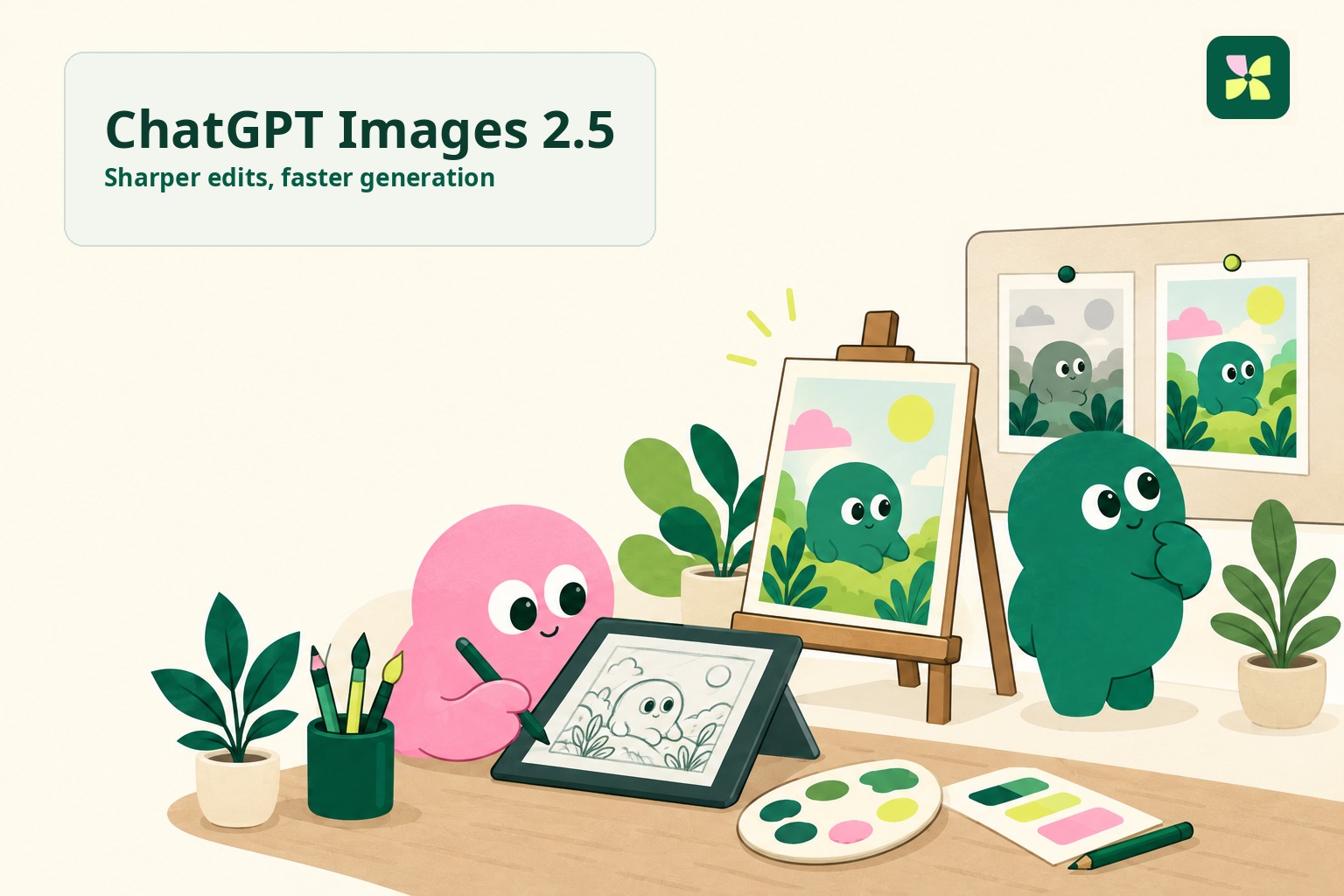
- Sketch: draw a rough layout or object directly in ChatGPT, then use it as a visual guide.
- Templates: start from formats such as posters, flyers, or product imagery rather than a blank prompt.
- Image comments: place comments directly on an image for more focused editing.
- Prompt sharing: share the prompt used to create an image so another person can adapt it to their own photos and details.
OpenAI says Sketch can be invoked with @Sketch in ChatGPT. The feature is described in the official announcement.
Availability and developer models
Images 2.5 is rolling out to ChatGPT, ChatGPT Work, and Codex users across all tiers on desktop, mobile, and web. The API release has two models:
- GPT-Image-2.5 Flare: the default option for most applications, with the same quality, editing, and speed improvements. OpenAI positions it for social content, product experiences, visual search, prototyping, and high-volume generation.
- GPT-Image-2.5 Sunburst: a higher-precision option for production creative and detailed product imagery, with longer generation times.
The announcement does not replace the need to check account access, rate limits, output sizes, and current API pricing before moving a workflow into production. Pricing is maintained on OpenAI's API pricing page.
Who benefits most
The update is most relevant to teams that repeatedly revise visual assets while keeping a product, person, layout, or brand treatment consistent:
- Marketing teams producing campaign variations and social assets.
- Retail and ecommerce teams adapting product imagery across formats.
- Creative teams that need a rough sketch to become a polished concept.
- Developers building image generation or editing into a product.
- Content operations teams that need a reviewable trail from brief to final asset.
The practical test is not whether one image looks impressive. It is whether the workflow preserves the parts that must stay fixed while changing the one part a reviewer requested.
How to evaluate it against other image tools
Teams comparing image systems should use the same references and the same edit sequence. Measure subject fidelity, edit locality, consistency after several turns, text rendering, latency, cost per approved asset, and the amount of human correction required. A single first-generation sample is not enough for a production decision.
For a brand workflow, keep the source brief, reference image, approvals, and final files in a shared workspace. This makes it easier to compare model versions without losing the reason behind each revision.
Why this matters for AI-native workspaces
A faster image model changes the generation step, but production work still needs a brief, source files, review ownership, permissions, and a place for the final asset to live. Kylon connects channels, agents, files, skills, connections, and workflows so teams can keep that context around the model call and hand the result to the next person.
Bottom line
- ChatGPT Images 2.5 focuses on fidelity, targeted editing, multi-turn consistency, and speed. OpenAI
- OpenAI says generation latency is up to 50% lower than Images 2.0. OpenAI
- Sketch, templates, image comments, and prompt sharing make the creative process more structured.
- GPT-Image-2.5 Flare and Sunburst are available through the API, with pricing listed separately. OpenAI pricing
- Teams should test repeated edits and cost per approved asset, not just visual quality on the first attempt.
Your first company harness. Where humans and agents run your business together.