Google DeepMind launches AlphaGenome Atlas for large-scale genomic research
Google DeepMind has introduced AlphaGenome Atlas, a searchable database that predicts the molecular effects of every possible single-letter DNA change. Here is what the atlas contains, how researchers can access it, and why it matters.
The short version
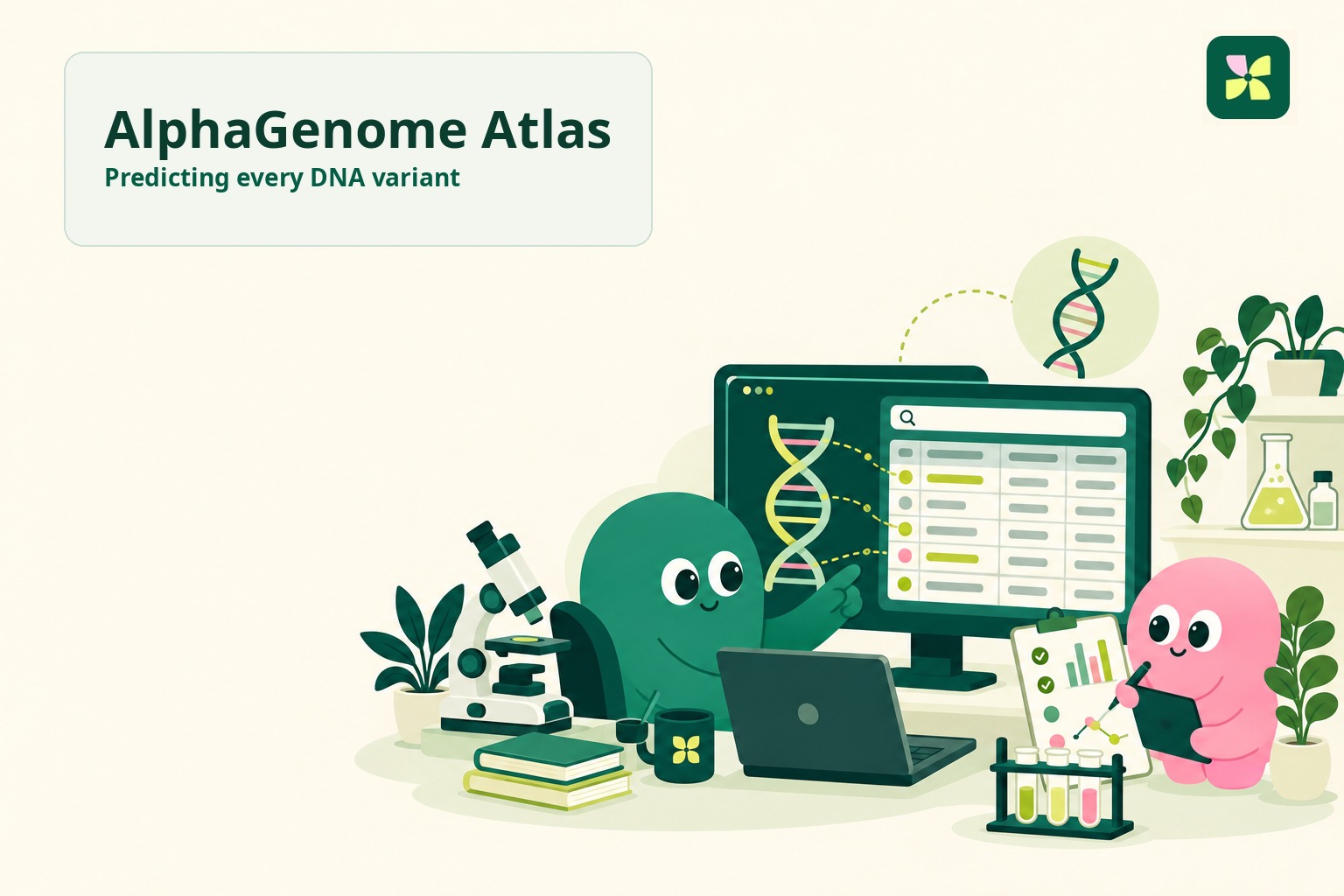
Google DeepMind has introduced AlphaGenome Atlas, a database that predicts the effects of every possible single-nucleotide variant in the human genome. The Atlas uses AlphaGenome to pre-calculate the regulatory impact of roughly 9 billion single-letter genetic changes, producing a dataset of about 1 petabyte. Google DeepMind's announcement is the source for these figures.
The release is a research access product rather than a new general-purpose chatbot. Its value is the ability to search a large set of precomputed predictions and prioritize variants for further scientific work.
What AlphaGenome Atlas contains
The human genome has about 3 billion base pairs. Google DeepMind says researchers understand protein-coding regions better than the remaining non-coding regions, where many regulatory effects are still difficult to interpret. AlphaGenome Atlas is intended to make those predictions easier to query. Google DeepMind
The Atlas introduces the AlphaGenome Variant Impact score, or AVI score. It combines predictions for coding and non-coding regions into a single prioritization signal, helping researchers narrow a large search space before running deeper analysis.
Examples from the announcement
Google DeepMind describes two early research examples:
- At the Broad Institute, researchers used the score to prioritize variants in rare disease research. The Atlas highlighted a variant in the DNM1 gene and predicted an incorrect splice site, providing supporting evidence for an unsolved case.
- Using data from more than 54,000 UK Biobank participants, a researcher grouped variants by predicted molecular effects and reported 22% more non-coding genetic associations. The work also identified 19 genetic regions linked to body mass index among the highest-impact variants.
These examples are reported by Google DeepMind and describe research support, not clinical diagnoses or proof that every prediction is correct. The official announcement should be read alongside the underlying research materials.
Access and availability
AlphaGenome Atlas is available through a web portal designed for researchers and biologists who do not want to write code for every query. Google DeepMind says the service is available today and is intended to broaden access to genomic predictions. Atlas portal
The announcement does not turn the resource into a clinical decision system. Researchers still need domain expertise, independent validation, appropriate datasets, and a clear separation between a model prediction and an established biological conclusion.
How it fits with AlphaFold
AlphaFold helped make protein-structure predictions searchable at large scale. AlphaGenome Atlas applies a similar access idea to genetic variation and regulatory effects, but the scientific objects are different. Protein structure, DNA sequence regulation, and clinical interpretation each require different validation methods.
The important product decision is the precomputed, searchable layer. Researchers can spend more time selecting hypotheses and less time building a first-pass query pipeline, while still treating the output as evidence for the next stage of work.
Who benefits most
The Atlas is most relevant to:
- Genomics researchers studying rare or non-coding variants.
- Biologists who need a visual query interface before using an API.
- Research teams prioritizing candidate variants for laboratory follow-up.
- Data scientists linking model predictions with cohort-level datasets.
- Organizations building reproducible research workflows around model outputs.
A useful evaluation should record the input variant, model output, score, dataset version, analyst decision, and any later validation. That record matters when several researchers revisit the same hypothesis.
Why this matters for AI-native research workflows
The hardest part of applied research is often not finding one model. It is keeping the question, data source, evidence, review, and next action connected. Kylon gives teams a shared place for research requests, source files, agent work, decisions, and repeatable workflows, so a model output can move into a reviewable research process rather than staying in one person's browser tab.
Bottom line
- AlphaGenome Atlas predicts the effects of every possible single-letter DNA change and makes the results searchable. Google DeepMind
- The dataset is about 1 petabyte and includes an AVI score for prioritization. Google DeepMind
- A web portal is available for researchers and biologists, with no coding required for basic access. Atlas portal
- The resource supports hypothesis generation and prioritization. It does not replace biological validation or clinical judgment.
Your first company harness. Where humans and agents run your business together.