Sales / App template
Industry sales CRM
Enquiries sit in email, conversations in chat, numbers in a spreadsheet, and the history in one person's head. This template gathers the sales process onto a single screen first, then lets email and chat flow into it. Eight starting points ship with it, each with its own labels, stages and deal sizes.
What it puts on screen
01
Your words, not CRM words
An enquiry is a Trial request, a Property enquiry or a Sponsor prospect, depending on what you actually call it. The template renames every object before it builds.
02
Five stages that match how you sell
One pipeline, five stages, set from your own process rather than a generic funnel. Deals that stopped moving are visible in the list.
03
Amounts that look like your business
Each starting point carries realistic deal sizes, so the first screen reads as a pipeline in motion instead of an empty shell.
04
A place for things to land
Put the sales process on one page first. Email, chat, the spreadsheets you keep today and the calendar come into it afterwards.
The screens
8 starting points
Same five stage structure, different words and different money. Pick the one closest to how you sell and change the rest in conversation.
Language school
Trial lesson through enrolment and renewal.
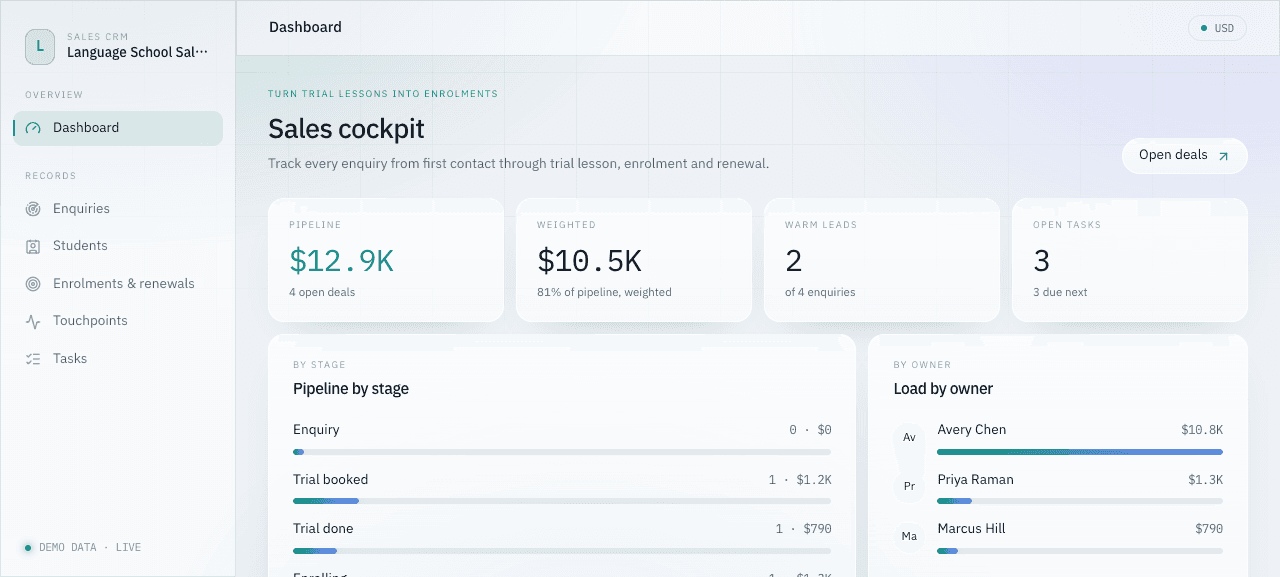
A school sells the second lesson, not the first. The enquiry becomes a Trial request and the customer becomes a Student, so the pipeline reads the way the front desk talks. Five stages carry someone from first enquiry to a booked trial, the trial itself, enrolment and then the renewal offer, with monthly class fees and corporate training sitting in the same amount field.
Download https://kylon.io/app-templates/industry-crm-demo-en.zip and register it as a skill in this workspace. Then use references/examples/language-school.json as the starting point and build a sales CRM demo for a language school. Call an enquiry a Trial request, a customer a Student, and use these five stages: Enquiry, Trial booked, Trial done, Enrolling, Renewal offer. Price classes around $200-400 a month, with corporate training in the several-thousand range.
Consulting
Enquiry through proposal, contract and follow-on work.
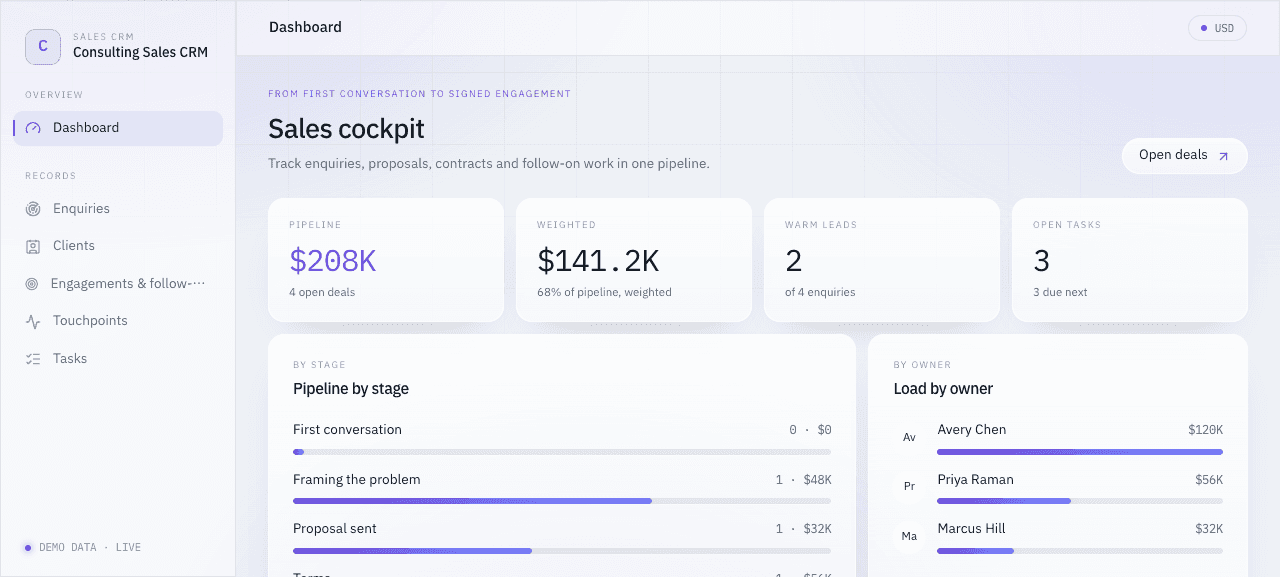
Consulting deals are slow and conversational, so the record has to hold a thread rather than a transaction. A deal is an Engagement, and the stages run from the first conversation through framing the problem, the proposal, terms and signature. It assumes engagements in the tens of thousands that take three to six months to close, which is what makes the follow up worth writing down.
Download https://kylon.io/app-templates/industry-crm-demo-en.zip and register it as a skill in this workspace. Then use references/examples/consulting.json as the starting point and build a sales CRM demo for a consulting firm. Call an enquiry an Enquiry, a deal an Engagement, and use these five stages: First conversation, Framing the problem, Proposal sent, Terms, Signed. Assume $30k-70k engagements that take three to six months to sign.
Real estate
Enquiry through viewings, applications and closing.
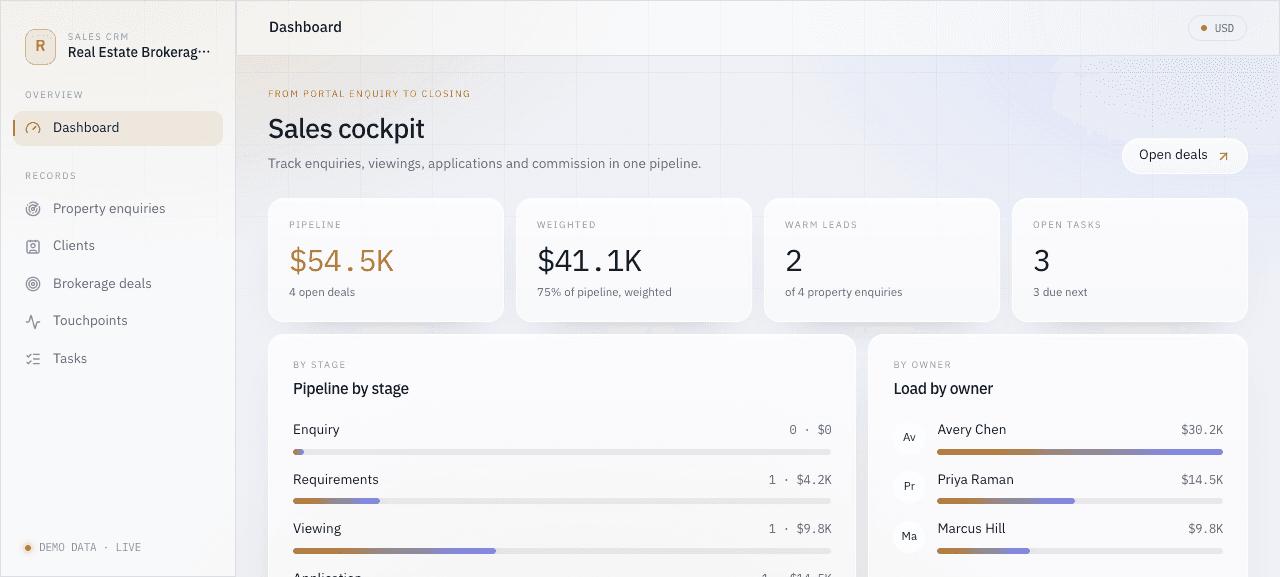
A brokerage lives on volume. Every enquiry is a Property enquiry and every deal a Brokerage deal, moving through requirements, viewing, application and close. Commission goes in the amount field rather than the property price, so the pipeline total is money the brokerage actually earns.
Download https://kylon.io/app-templates/industry-crm-demo-en.zip and register it as a skill in this workspace. Then use references/examples/property.json as the starting point and build a sales CRM demo for a brokerage. Call an enquiry a Property enquiry, a deal a Brokerage deal, and use these five stages: Enquiry, Requirements, Viewing, Application, Closed. Put the commission in the amount field and assume dozens of enquiries a day.
Community sponsorship
Prospects through proposal and contract.
Sponsorship selling is prospecting plus a long proposal cycle. A lead is a Sponsor prospect and a deal a Sponsorship, shortlisted first, then first contact, proposal, terms and signature. Annual partnerships and one off title sponsorships share the board, so a renewal conversation and a new logo are visible side by side.
Download https://kylon.io/app-templates/industry-crm-demo-en.zip and register it as a skill in this workspace. Then use references/examples/sponsorship.json as the starting point and build a sponsorship sales CRM demo for a community operator. Call a lead a Sponsor prospect, a deal a Sponsorship, and use these five stages: Shortlisted, First contact, Proposal, Terms, Signed. Mix annual partnerships with one-off title sponsorships, from $5k to $50k.
Retail and wholesale
Enquiry through quote, order and reorder.
Wholesale orders arrive as enquiries and leave as repeat business. A lead is a Business enquiry and a deal an Order, with samples as their own stage between requirements and the quote, because that is where most B2B orders stall. Corporate gifting and bulk runs sit in the same list.
Download https://kylon.io/app-templates/industry-crm-demo-en.zip and register it as a skill in this workspace. Then use references/examples/retail.json as the starting point and build a B2B sales CRM demo for a retail and wholesale business. Call a lead a Business enquiry, a deal an Order, and use these five stages: Enquiry, Requirements, Samples, Quote sent, Ordered. Assume corporate gifting and bulk orders worth $5k-50k each.
Ecommerce
Subscription retention and repeat purchase.
Retention is a pipeline too. Here a lead is a Purchase signal and a deal an Opportunity, moving from a detected signal to an offer prepared, sent, purchased and finally subscribed. Order values stay in the tens to low hundreds and lapsing customers are in the list on purpose, since they are the reason to look at it.
Download https://kylon.io/app-templates/industry-crm-demo-en.zip and register it as a skill in this workspace. Then use references/examples/ecommerce.json as the starting point and build a retention CRM demo for an ecommerce brand. Call a lead a Purchase signal, a deal an Opportunity, and use these five stages: Signal detected, Offer prepared, Offer sent, Purchased, Subscribed. Keep order values between $50 and $400 and include customers showing signs of lapsing.
Membership community
Joining and annual renewal.
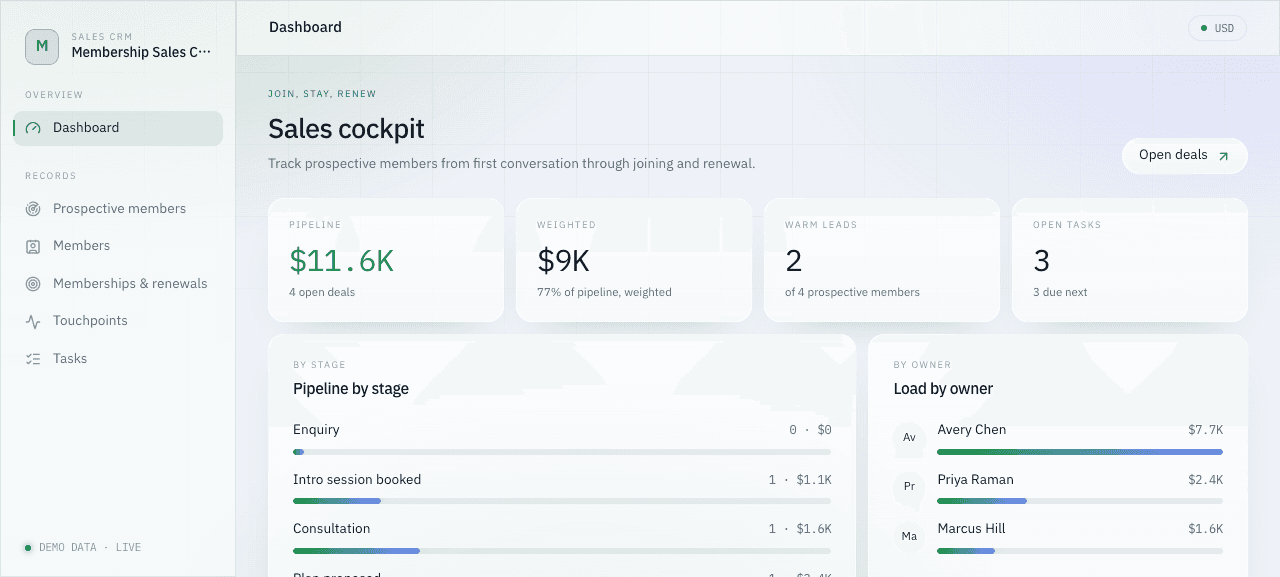
A membership business is a renewal business. A lead is a Prospective member and a deal a Membership, through an intro session, consultation, proposed plan and the join or renew moment. Annual fees run from a few hundred to a few thousand, and people approaching renewal are easy to pick out of the board.
Download https://kylon.io/app-templates/industry-crm-demo-en.zip and register it as a skill in this workspace. Then use references/examples/membership.json as the starting point and build a sales CRM demo for a membership community. Call a lead a Prospective member, a deal a Membership, and use these five stages: Enquiry, Intro session booked, Consultation, Plan proposed, Joined or renewed. Annual fees run $500-5,000, and members close to renewal should be easy to spot.
Personal training
Trials through joining and renewal.
A studio sells trials and keeps people through the plan. A lead is a Trial request and a deal a Membership, through trial, consultation, proposed plan and signature or renewal. Leads come in from Instagram, messaging apps and referrals rather than a form, so the record is built to be filled in from a conversation.
Download https://kylon.io/app-templates/industry-crm-demo-en.zip and register it as a skill in this workspace. Then use references/examples/membership.json as the starting point and build a sales CRM demo for a personal training studio. Call a lead a Trial request, a deal a Membership, and use these five stages: Enquiry, Trial booked, Consultation, Plan proposed, Signed or renewed. Leads come from Instagram, messaging apps and referrals; plans run $1,000-2,500, with corporate wellness in the several-thousand range.
Questions people ask first
Is this a fixed CRM template, or can the fields change?
The stages, the names and the fields are the part you are meant to change. The instruction sets a starting point, then you tell your agent in plain words what to rename, add or drop, and it edits the App in place.
Do I need to know SQL or write any code?
No. The agent creates the App, applies the database migrations and seeds the demo rows. You read the screen and say what is wrong with it.
What if my business is not one of the eight?
Take the closest starting point and describe your own process in the same instruction. The eight exist because most sales processes differ in labels and stages rather than in structure.
Can email and chat feed into it?
Yes, and that is the reason to keep the pipeline inside the workspace rather than in a spreadsheet. Once the App exists, an agent in the same room can read a thread and update the record behind an approval.
Paste this at your agent
Paste one of these at the agent in your own workspace. The instruction carries the archive URL, so the agent fetches and registers it itself, and only the first time.
One instruction per starting point, each with the labels, stages and deal sizes of that business. Go to the 8 starting points.
Prefer to read it first? Download the archive. industry-crm-demo-en.zip. Starting points for eight industries, plus the whole interface.
Read next
- What an AI CRM isThe wider picture: how an agent operated CRM differs from a system of record you fill in by hand.
- CRM data entry, automatedWho updates the record after a call or an email, and what the agent asks before it writes.
- CRM workflow automationFollow ups and handoffs without building the workflow yourself first.
More in the gallery
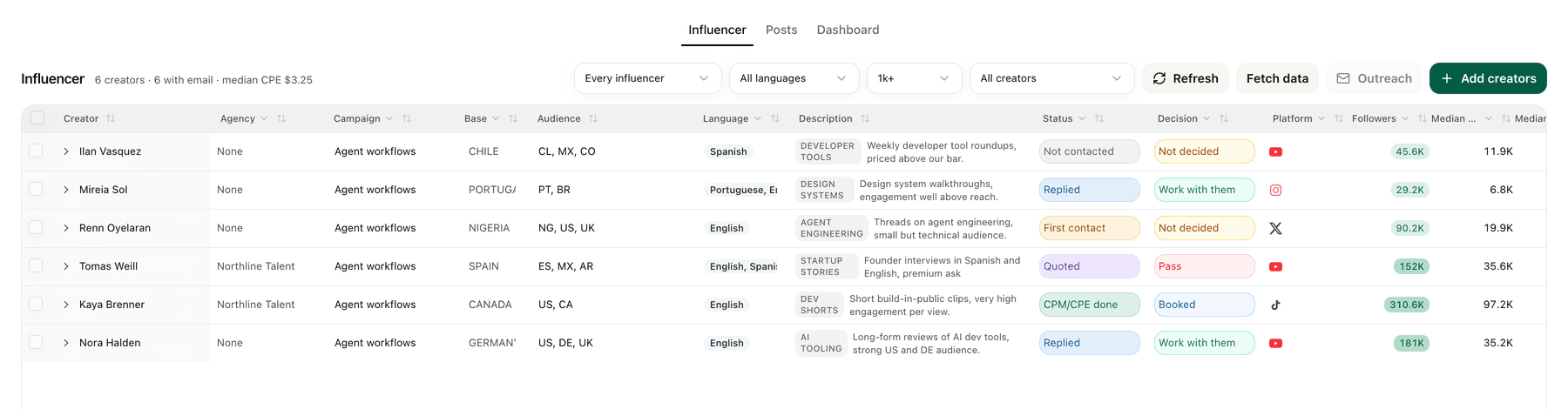
Marketing / App template
Creator CRM
A creator roster priced against the median of each creator's last ten posts, with outreach and posts tracked through to signups.
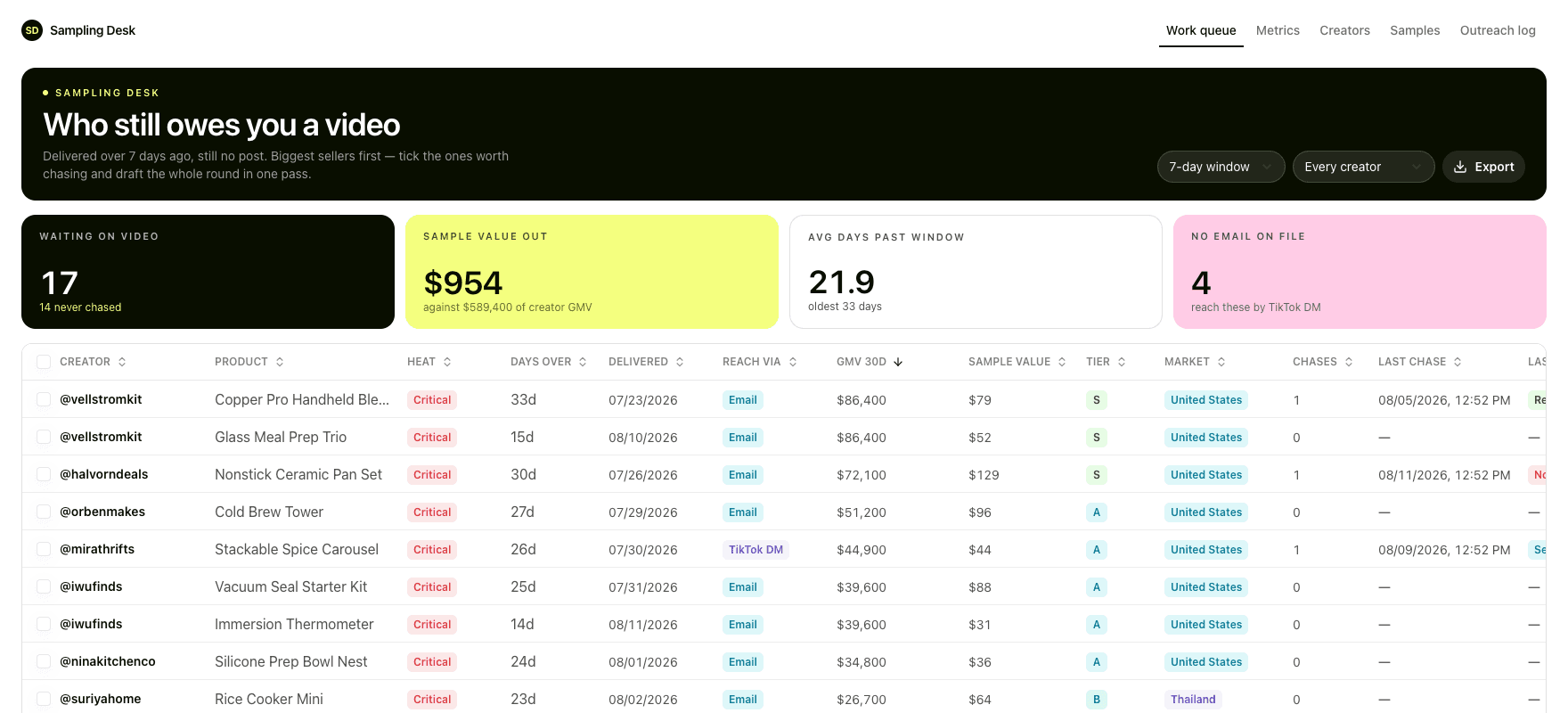
Ecommerce / App template
TikTok Shop sampling desk
One queue for the samples that shipped and never became a video, biggest seller first.
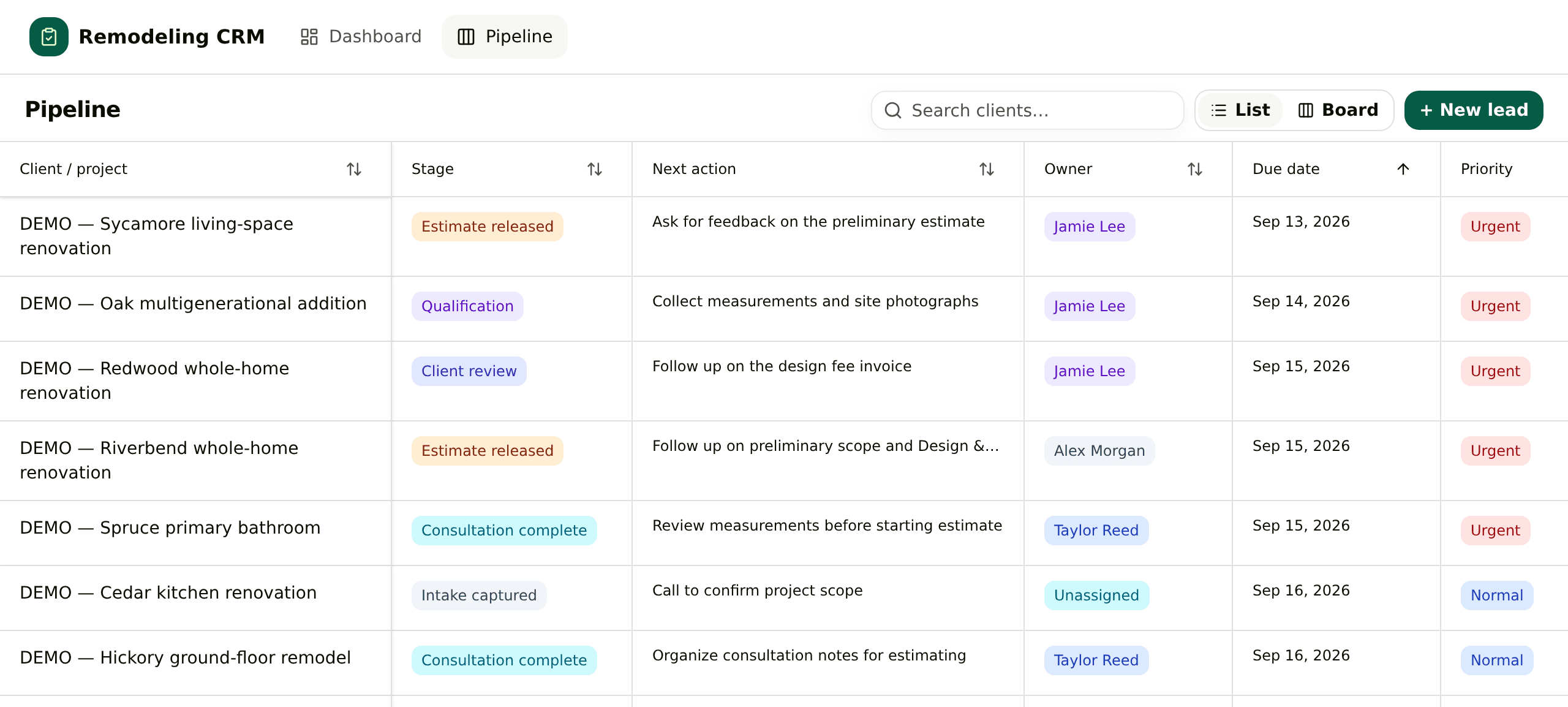
Construction / App template
Remodeling CRM
One board for residential renovation sales: qualify, consult, estimate, then collect the Design and Discovery fee.
Yours will not look exactly like this.
That is the point. The template gives your agent a running start, then the two of you change it until it matches how the work actually goes.