Investment Firms and Family Offices: Every Deal, Request and Report on One Record
Intros, diligence lists, portfolio updates and the quarterly letter to principals run through a few people and their inboxes. This is how that work runs in Kylon rooms on one shared record, with a partner approving everything that leaves the firm.
A small team at the end of a long funnel
An investment team is usually a handful of people doing the work of a much larger one. In a survey of 885 institutional venture capitalists published through the National Bureau of Economic Research, respondents described an average firm of 14 employees and 5 senior investment professionals, and a median firm that considers about 100 opportunities for every deal it closes, rising to 151 for firms focused on information technology (NBER, How Do Venture Capitalists Make Decisions?, checked 29 September 2026).
Most of that flow arrives through people. The same respondents said over 30 percent of deals came through professional networks and 20 percent were referred by other investors, with only 10 percent arriving inbound from the companies themselves (NBER digest, checked 29 September 2026). Every intro is an email thread with a relationship attached to it, and losing track of who made the introduction costs more than losing the deck.
Once a deal is live, the work gets heavier. The paper behind that survey reports that the average deal takes 83 days to close, with about 118 hours of due diligence and 10 reference calls, and that respondents spend 18 hours a week working with portfolio companies (Gompers, Gornall, Kaplan and Strebulaev, NBER Working Paper 22587, checked 29 September 2026).
Most funds stay small. Of the 2,775 venture funds in Carta's Q1 2026 fund performance dataset, about 89 percent are smaller than 100 million dollars, and the majority of funds closed are smaller than 25 million dollars (Carta, VC Fund Performance: Q1 2026, published 4 June 2026, checked 29 September 2026). At that size, research, diligence tracking and investor reporting sit with the same few people who make the investment decisions.
Family offices carry the same load in a different shape. J.P. Morgan Private Bank's survey of 333 family offices across 30 countries put the average annual operating cost at 3 million dollars, with 40 percent spending less than 1 million, and found that 80 percent outsource some part of portfolio management, with legal services the most outsourced function at 52 percent (J.P. Morgan Private Bank, 2026 Global Family Office Report, published 2 February 2026, checked 29 September 2026). A lean office runs on outside counsel, tax advisers, fund managers and administrators, and someone inside has to keep every one of those threads moving.
The tooling behind that coordination is thin. In the AlTi Tiedemann Global and Campden Wealth study of 146 single family offices, 42 percent still rely on spreadsheets, 70 percent report difficulty hiring staff, and only about 25 percent report consistently excellent service from their growing list of providers (Campden Wealth, Family Office Operational Excellence Report 2025, published 12 June 2025, checked 29 September 2026).
One room per deal, one record for the firm
The setup follows the work. The team keeps a deal-flow room where new opportunities land, a room for each live deal or portfolio area, and one Database App behind all of them. Every company is a record: source, who introduced it, stage, owner, next step, the memo, the diligence checklist and every update it has sent since the investment.
The agents in those rooms read the same record the partners read, and write to it. When counsel replies, the checklist item changes. When a founder sends the monthly update, the numbers land on the company. The firm's memory moves out of individual inboxes and onto the record.
- Pipeline records carrying source, introducer, stage, owner and next step
- Diligence requests per item and per counterparty, with the date asked and the file received
- Portfolio updates read into each holding, period by period
- Room guidelines setting tone, what may be drafted and what a partner must approve
What arrives, what gets prepared, who decides
Investment work has a clear line between preparation and judgement, and the room guidelines write it down. Agents prepare. The investment view, every commitment and everything sent outside the firm stay with a partner.
| What arrives | What is prepared for you | What a person decides |
|---|---|---|
| An intro email arrives with a deck attached | A pipeline record with company, source, introducer and stage, plus a one-page summary of the deck | Whether to take the meeting |
| A first meeting is booked | A brief built from the deck, the company's site, public news and the firm's earlier notes | The questions worth asking |
| A partner wants a first-pass memo | A draft in the firm's memo template, each claim linked to the document behind it | The investment view, and whether it goes to committee |
| Diligence starts | A request list built from the firm's checklist, drafted per counterparty: the company, its counsel, its accountants | What is asked of whom, and the send |
| Portfolio companies send monthly updates in different formats | Metrics read into each holding's record, with changes against last period and missing items flagged | What to follow up, and with whom |
| The quarter ends | A draft update for principals or LPs built from the record | Every figure and every sentence before it leaves the firm |
Deal flow that keeps its source
When an intro lands in the connected mailbox, the agent opens a pipeline record, attaches the deck, writes a one-page summary and records who made the introduction. If the company is already in the pipeline, the new thread joins the existing record.
Before a first meeting, the agent drafts a brief from the deck, the company's own site, public news and the firm's earlier notes on the space, with a link beside every claim. Declines are drafted too, in the firm's voice, and a partner sends them, because the founder who hears no today may be the introducer next year.
For standing coverage of a sector, the same approach runs on a schedule. See how a team set up continuous market intelligence in Kylon rooms.
See it in action
The agent reports what is still missing from the data room, the partner asks for the request in one line, and the email to company counsel comes back drafted and held. Send is a partner, not a setting.
Diligence as a tracker, not a thread
A diligence list is dozens of items spread across the company, its counsel, its accountants and sometimes a co-investor. In the room, each item is a row with who it was asked of, when, and what came back. When a file arrives, the agent saves it to the deal folder in Google Drive, closes the item and notes anything that differs from what was asked for.
Items that go quiet get a follow-up drafted with the specific document named. Outside advisers get the same treatment: the firm's own counsel and tax advisers receive requests that name the deal, the item and the date, and their replies attach to the deal rather than to one partner's inbox.
Portfolio updates and the quarter
After the investment, the flow reverses. Portfolio companies send monthly updates in every format, fund managers send notices, and news arrives about the companies you hold. The agent reads each update into the portfolio record, lists what changed since the last period and flags the metrics a company stopped reporting.
When the quarter ends, the update to principals or LPs is a read of that record. The draft covers holdings, capital calls and distributions, pipeline and the decisions ahead, with every line linking back to where it came from. Values and the investment view are the partners' own, carried as approved. Many offices already run this discipline: in UBS's survey of 307 family offices, 60 percent operate with investment committees and 68 percent have formal financial performance measurement processes (UBS, Global Family Office Report 2026, published 28 May 2026, checked 29 September 2026).
Why the partner holds the send
Family offices are divided on how far to trust new tools with the work. In the RBC and Campden Wealth survey of 155 North American family offices, 40 percent described AI as embedded and essential to their workflow, while 38 percent disagreed (RBC Wealth Management, North America Family Office Report 2026, published 29 September 2026, checked 29 September 2026).
A room with a partner on every outbound message works for both camps. The agent drafts the memo, the request and the update. A partner reads, edits and sends, and the approval stays in the thread next to the draft.
What has to be connected
Kylon sits across the tools the firm already runs and holds the coordination between the team, the companies and the advisers.
- Email, Gmail or Outlook, so intros, requests and replies attach to the company rather than to a person
- Google Drive for decks, data room exports, memos and signed documents
- Calendar, so meeting prep starts from what is actually booked
- A Database App as the pipeline, diligence and portfolio record the team and its agents both read
- Room membership, so each deal room holds only the people and agents working that deal
For the wider picture across finance teams, see financial services use cases.
Where to start
Take the deal-flow inbox and one live deal. Put the pipeline fields and your diligence checklist into a Database App, connect the mailbox where intros already arrive, and write down the one rule that matters: an agent may draft a memo, a request or an update, and a partner sends it.
“The partners still make every call. What changed is that the intro from March, last week's reply from counsel and the September update all sit on the same record.”
Your first company harness. Where humans and agents run your business together.
More Use Cases
View all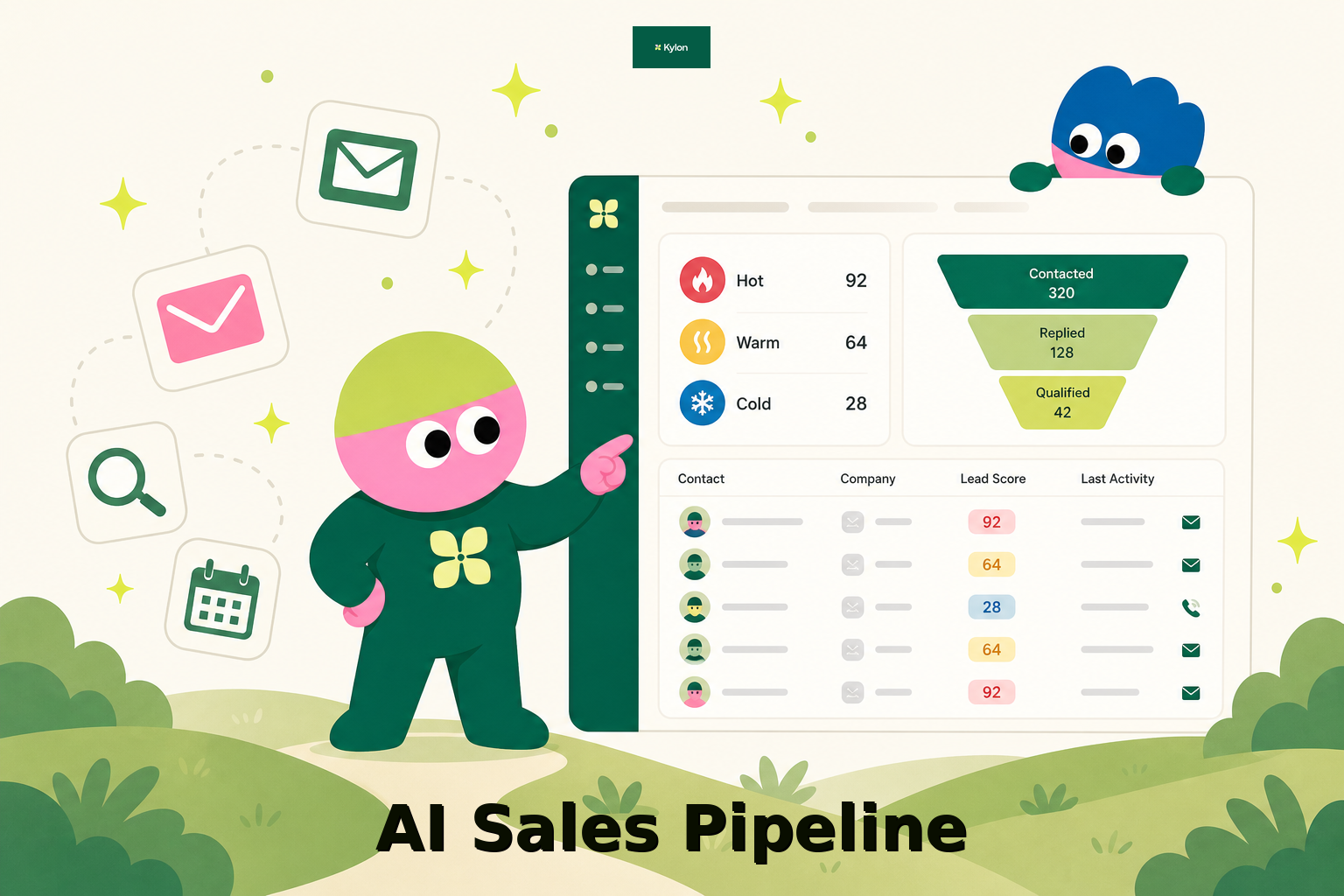
How a US Hospitality Firm Built an AI Sales Pipeline with Kylon
A US-based hospitality company used Kylon to automate 1,000-contact outreach, AI reply scoring, and lead routing.
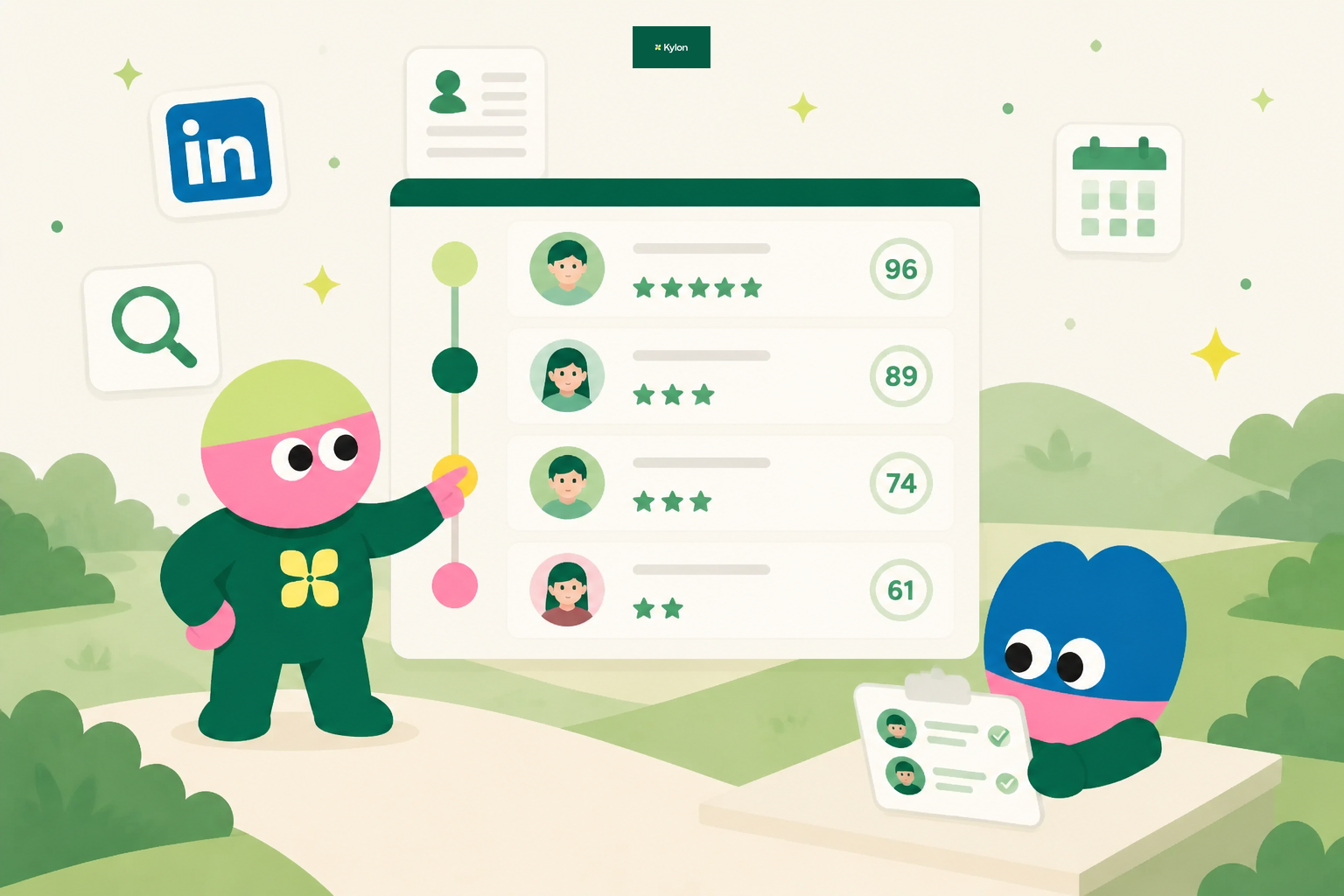
How an AI Startup Automated Talent Sourcing with Kylon
A growing AI startup built a recruiting system where agents parse resumes, score candidates against open roles, and manage outreach, all from one room with a structured database.